MCQ
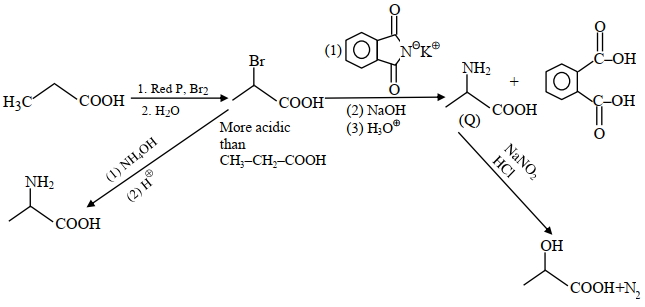
Considering the reaction sequence given below, the correct statement($s$) is(are)

$(A)$ $P$ can be reduced to a primary alcohol using $NaBH _4$.

$(B)$ Treating $P$ with conc. $NH _4 OH$ solution followed by acidification gives $Q$.

$(C)$ Treating $Q$ with a solution of $NaNO _2$ in aq. $HCl$ liberates $N _2$.

$(D)$ $P$ is more acidic than $CH _3 CH _2 COOH$.

  • $B,C,D$
  • B
    $B,C,A$
  • C
    $B,C$
  • D
    $B,D$

Answer

Correct option: A.
$B,C,D$
a

Need a full question paper?

Generate a complete, print-ready paper with questions like this in minutes — across 16+ boards, with answer keys.

Start Generating Free

Similar questions

Considering the basic strength of amines in aqueous solution, which one has the smallest $pK_b$ value ?
Out of $TiF_6^{2-}, CoF_6^{3-}, Cu_2Cl_2$ and $NiCl_4^{2-}$  $(Z$ of $Ti = 22, Co = 27, $$Cu = 29, Ni = 28)$ the colourless species are
What will be the decreasing order of basic strength of the following conjugate bases?

${ }^{-} \mathrm{OH}, \mathrm{R} \overline{\mathrm{O}}, \mathrm{CH}_3 \mathrm{CO} \overline{\mathrm{O}}, \mathrm{C} \overline{1}$

Number of unhybridised orbitals in vinyl acetylene are
Chemical reactions involve interaction of atoms and molecules. A large number of atoms/molecules (approximately $6.023 \times 10^{23}$ ) are present in a few grams of any chemical compound varying with their atomic/molecular masses. To handle such large numbers conveniently, the mole concept was introduced. This concept has implications in diverse areas such as analytical chemistry, biochemistry, electrochemistry and radiochemistry. The following example illustrates a typical case, involving chemical/electrochemical reaction, which requires a clear understanding of the mole concept.

A $4.0$ molar aqueous solution of $\mathrm{NaCl}$ is prepared and $500 \mathrm{~mL}$ of this solution is electrolysed. This leads to the evolution of chlorine gas at one of the electrodes (atomic mass: $\mathrm{Na}=23, \mathrm{Hg}=200 ; 1$ Faraday $=96500$ coulombs)

$1.$ The total number of moles of chlorine gas evolved is

$(A)$ $0.5$  $(B)$ $1.0$  $(C)$ $2.0$  $(D)$ $3.0$

$2.$  If the cathode is a $\mathrm{Hg}$ electrode, the maximum weight ( $\mathrm{g}$ ) of amalgam formed from this solution is

$(A)$ $200$  $(B)$ $225$  $(C)$ $400$  $(D)$ $446$

$3.$ The total charge (coulombs) required for complete electrolysis is

$(A)$ $24125$  $(B)$ $48250$  $(C)$ $96500$  $(D)$ $193000$

Give the answer question $1,2$ and $3.$
$\begin{array}{*{20}{c}}
  {IR - \mathop {\mathop O\limits^{ \bullet  \bullet } }\limits^ \oplus   - R'} \\ 
  | \\ 
  H 
\end{array} \to RI + R'OH$

true about this mechanism

Which acid has least $p{K_a}$ value
Select the correct matching
List $-I$ List $-II$
$A$ $XeF_4$ $1.$ Pyramidal
$B$ $XeF_6$ $2.$ $T-$ shape
$C$ $XeO_3$ $3.$ Distorted octahedral
$D$ $XeOF_2$ $4.$ Square planar
Which of following is not product of reaction ?
Which of the following arrangements shows the correct order of decreasing paramagnetism?