MCQ
Consists of two statements, namely, Assertion $(A)$ and Reason $(R).$ For selecting the correct answer, use the following code:
Assertion (A)
Reason (R)
Three rational numbers between $\frac{2}{3}$ and $\frac{3}{5}$ are $\frac{9}{20},\frac{10}{20}$ and $\frac{11}{20}.$
A rational number between two rational numbers $p$ and $q$ is $\frac{1}{2}(\text{p}+\text{q}).$
The correct answer is: $(a), (b), (c), (d).$
  • Both Assertion $(A)$ and Reason $(R)$ are true and Reason $(R)$ is a correct explanation of Assertion $(A).$
  • B
    Both Assertion $(A)$ and Reason $(R)$ are true but Reason is not a correct explanation of Assertion $(A).$
  • C
    Assertion $(A)$ is true and Reason $(R)$ is false.
  • D
    Assertion $(A)$ is false and Reason $(R)$ is true.
Answer

Correct option: A.
Both Assertion $(A)$ and Reason $(R)$ are true and Reason $(R)$ is a correct explanation of Assertion $(A).$
We know that $\frac{1}{2}(\text{p}+\text{q})$ is a rational number between two given rational numbers $p$ and $q.$ Thus, Reason $(R)$ is true.
A rational number between $\frac{2}{5}$ and $\frac{3}{5}$ is $\frac{1}{2}\Big(\frac{2}{5}+\frac{3}{5}\Big)=\frac{5}{10}$
A rational number between $\frac{2}{5}$ and $\frac{5}{10}$ is $\frac{1}{2}\Big(\frac{2}{5}+\frac{5}{10}\Big)=\frac{9}{20}$
A rational number between $\frac{5}{10}$ and $\frac{3}{5}$ is $\frac{1}{2}\Big(\frac{5}{10}+\frac{3}{5}\Big)=\frac{11}{20}$
$\therefore$ Three rational numbers between $\frac{2}{5}$ and $\frac{3}{5}$ are $\frac{9}{20},\frac{10}{20}$ and $\frac{11}{20}$
Thus, Assertion $(A)$ is true
Since Reason $(R)$ gives Assertion $(A),$ so $(a)$ holds.

Need a full question paper?

Generate a complete, print-ready paper with questions like this in minutes — across 16+ boards, with answer keys.

Start Generating Free

Similar questions

Directions: In the following questions, the Assertions $(A)$ and Reason(s) $(R)$ have been put forward. Read both the statements carefully and choose the correct alternative from the following:
Assertion: The difference between the maximum and minimum values of a variable is called its range.
Reason: The number of times a variate (observation) occurs in a given data is called range.
Directions: In the following questions, the Assertions $(A)$ and Reason(s) $(R)$ have been put forward. Read both the statements carefully and choose the correct alternative from the following:
Assertion: If the perpendicular distance of a point $P$ from the $x$ - axis is $7$ units and the foot of the perpendicular lies on the negative direction of $x$ - axis, then the point $P$ has $y$ coordinate is $7$ or $-7$ only.
Reason: The coordinates of any point on the $y$ - axis are of the form $(0, k)$, where $|k|$ is the distance of the point from the $x$ - axis.
Directions: In the following questions, the Assertions $(A)$ and Reason(s) $(R)$ have been put forward. Read both the statements carefully and choose the correct alternative from the following:
Assertion: A segment has leangth.
Reason: Three lines are concurrent if they have common points.
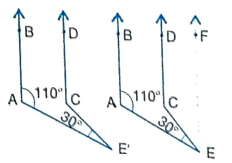
Statement-1 (A): In Fig., if $A B \| C D, \angle E A B=110^{\circ}$ and $\angle A E C=30^{\circ}$, then$\angle D C E=140^{\circ}$
Statement-2 (R): If two parallel lines are intersected by a tramsubersal, then each pair of alternate angles are equal.
Image
Directions: In the following questions, the Assertions $(A)$ and Reason(s) $(R)$ have been put forward. Read both the statements carefully and choose the correct alternative from the following:
Assertion: Every square is a rectangle.
Reason: Every rectangle is a square
Directions: In the following questions, the Assertions $(A)$ and Reason(s) $(R)$ have been put forward. Read both the statements carefully and choose the correct alternative from the following:
Assertion: The region between the arc and the two radii, joining the centre to the end points of the arc is called minor arc.
Reason: The region between a chord and either of its arc is called major arc.
Directions: In the following questions, the Assertions $(A)$ and Reason(s) $(R)$ have been put forward. Read both the statements carefully and choose the correct alternative from the following:
Assertion: If the angles of a quadrilateral are in the ratio $2 : 3 : 7 : 6,$ then the measure of angles are $40^\circ , 60^\circ , 140^\circ , 120^\circ $ respectively.
Reason: The sum of the angles of a quadrilateral is $360^\circ .$
Statement-1 (A): The graph of the linear equation $4 x+3 y=24$ mects $x$-axis at (-6,0).
Statement-2 (R): Points on $x$-axis are of the form (a, 0), where a is a variable.
Directions: In the following questions, the Assertions $(A)$ and Reason(s) $(R)$ have been put forward. Read both the statements carefully and choose the correct alternative from the following:
Assertion: A Cartesian plane consists of two mutually perpendicular lines intersecting at their zeros.
Reason: The Cartesian plane consists of two perpendicular and directed lines whose intersection point is the zero point for both the lines.
Statement-1 (A): Every parallelogram is a rectangle.
Statement-2 (R): The angle bisectors of a parallelogram form a rectangle.