Question
Constantan wire is used for making standard resistance, because it has:

Answer

  1. Negligible temperature coefficient of resistance.
Explanation:
Constantan is a copper-nickel alloy. Its main feature is its resistivity, which is constant over a wide range of temperatures. Thus it has low temperature coefficient of resistance.that's why it is used for making of standard resistances.

Need a full question paper?

Generate a complete, print-ready paper with questions like this in minutes — across 16+ boards, with answer keys.
Start Generating Free

Similar questions

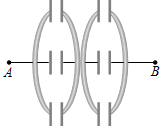
All six capacitors shown are identical, Each can withstand maximum $200$ volts between its terminals. The maximum voltage that can be safely applied between $A$ and $B$ is
Intrinsic semiconductor is electrically neutral. Extrinsic semiconductor having large number of current carriers would be (a) Positively charged(b) Negatively charged(c) Positively charged or negatively charged depending upon the type of impurity that has been added(d) Electrically neutral


The capacitance is measured in:
What is the radius of iodine atom $($at. no. $53,$ mass number $126)$
A man who cannot see clearly beyond 5 m wants to see stars clearly. He should use a lens of focal length(a) – 100 m(b)  + 5 m(c) – 5 m (d) Very large 
       
A coil carrying electric current is placed in uniform magnetic field, then(a) Torque is formed(b) E.M.f. is induced(c) Both (a) and (b) are correct(d) None of these
   
   
An e.m.f. of 100 millivolts is induced in a coil when the current in another nearby coil becomes 10 ampere from zero in 0.1 second. The coefficient of mutual induction between the two coils will be(a) 1 millihenry(b) 10 millihenry(c) 100 millihenry(d) 1000 millihenry
       
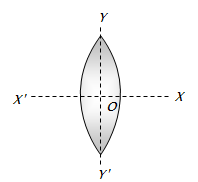
An equiconvex lens is cut into two halves along $\ce{(i) XOX¢}$ and $\ce{(ii) YOY¢}$ as shown in the figure. Let $\ce{f, f ¢, f ¢¢}$ be the focal lengths of the complete lens, of each half in case $(i),$ and of each half in case $(ii),$ respectively

Choose the correct statement from the following
The dispersive power of the material of lens of focal length 20 cm is 0.08. The longitudinal chromatic aberration of the lens is(a) 0.08 cm(b) 0.08/20 cm(c) 1.6 cm(d) 0.16 cm
       
In an interference experiment, the spacing between successive maxima or minima is  $($Where the symbols have their usual meanings$)$