Question
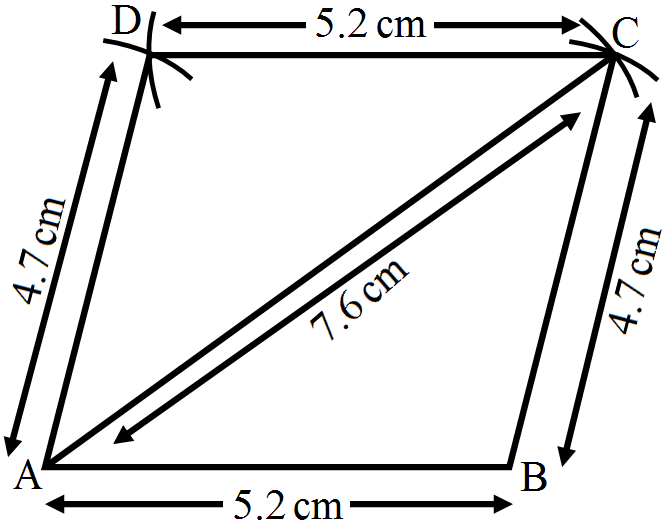
Construct a parallelogram ABCD in which AB = 5.2cm, BC = 4.7cm and AC = 7.6cm.

Answer


Steps of construction:
Step 1: Draw AB = 5.2cm.
Step 2: With B as the centre, draw an arc of 4.7cm.
Step 3: With A as the centre, draw another arc of 7.6cm, cutting the previous arc at C.
Step 4: Join A and C.
Step 5: We know that the opposite sides of a parallelogram are equal. Thus, with C as the centre, draw an arc of 5.2cm.
Step 6: With A as the centre, draw another arc of 4.7cm, cutting the previous arc at D.
Step 7: Join CD and AD.
Then, ABCD is the required parallelogram.

Need a full question paper?

Generate a complete, print-ready paper with questions like this in minutes — across 16+ boards, with answer keys.
Start Generating Free

Similar questions

Construct a square, each of whose sides measures 6.4cm.
Find a number such that when 5 is subtracted from 5 times the number, the result is 4 more than twice the number.
A can do a piece of work in 14 days while B can do it in 21 days.They began together and worked at it for 6 days. Then, A fell ill and B had to complete the remaining work alone. In how many days was the work completed?
Construct a frequency table with equal class intervals from the following data on the monthly wages (in rupees) of 28 labourers working in a factory, taking one of the class intervals as 210-230 (230 not included):
220, 268, 258, 242, 210, 268, 272, 242, 311, 290, 300, 320, 319, 304, 302, 318, 306, 292, 254, 278, 210, 240, 280, 316, 306, 215, 256, 236.
The cost of fencing a square field at 60 paise per metre is Rs. 1200 . Find the cost of reaping the field at the rate of 50 paise per 100 sq . metres.
Find the area of a quadrilateral one of whose diagonals is 40 cm and the lengths of the perpendiculars drawn from the opposite vertices on the diagonal are 16 cm and 12 cm .
Take away:
$\frac{6}{5}\text{x}^{2}-\frac{4}{5}\text{x}^3+\frac{5}{6}+\frac{3}{2}\text{x}$ from $\frac{\text{x}^3}{3}−\frac{5}{2}\text{x}^2+\frac{3}{5}\text{x}+\frac{1}{4}$
Solve:
$\frac{\text{2x}+7}{5}-\frac{\text{3x}+11}{2}=\frac{2\text{x}+8}{3}-5$
Verify the following:
$\frac{-13}{24}\times\Big(\frac{-12}{5}\times\frac{35}{36}\Big)=\Big(\frac{-13}{24}\times\frac{-12}{5}\Big)\times\frac{35}{36}$
Solve:
$\frac{3(\text{y}−5)}{4}−4\text{y}=3-\frac{(\text{y}-3)}{2}$