Question
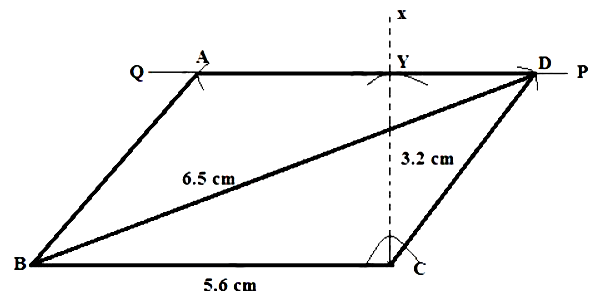
Construct a parallelogram $\text{ABCD},$ when:Base $BC = 5.6 \ cm,$ diagonal $BD = 6.5 \ cm$ and altitude $= 3.2 \ cm.$

Answer


Steps:
$1$. Draw $BC =5.6 \ cm$.
$2$. At $C$, draw $CX$ perpendicular to $BC$.
$3.$ with $C$ as a centre and taking radius $3.2 \ cm$ to draw an arc to cut $C X$ at $Y.$
$4.$ Through $Y$ draw a straight line $PQ$ parallel to $BC.$
$5.$ With $B$ as a centre and radius, $6.5 \ cm$ draw an arc to meet $PQ$ at $D$.
$6.$ With $D$ as a centre and radius equal to $5.6 \ cm$, draw an arc to meet $PQ$ at $A.$
$7$.Join $BA, BD$ and $CD.$
$\text{ABCD}$ is the required parallelogram.

Need a full question paper?

Generate a complete, print-ready paper with questions like this in minutes — across 16+ boards, with answer keys.
Start Generating Free

Similar questions

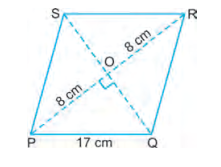
In a rhombus PQRS , side $PQ =17 cm$ and diagonal $PR =16 cm$.
Calculate the area of the rhombus.
Image
Rohit says to Ajay, $“\ $Give mehundred, I shall then become twice as rich as you.$”\ $ Ajay replies, $“\ $if you give me ten, I shall be six times as rich as you.$”\ $ How much does each have originally ?
If $\log x^2-\log \sqrt{y}=1$, express $y$ in terms of $x$. Hence find $y$ when $x =2$.
If $\tan x =1 \frac{1}{3},$ find the value of $: 4 \sin^2x - 3 \cos^2x + 2$
Express the following as a single logarithm:$2 \log \frac{9}{5}-3 \log \frac{3}{5}+\log \frac{16}{20}$
If $\tan \theta=\frac{5}{12}$ and $\theta$ is acute, find the values of sin $\theta$ and cos $\theta$.
A kite is attached to a $100\ m$ long string. Find the greatest height reached by the kite when its string makes an angles of $60^\circ$ with the level ground.
The medians of a $\triangle ABC$ intersect each other at point $G$. If one of its medians is $AD,$prove that:$(i)$ Area$ ( \triangle ABD ) = 3 \times$ Area $( \triangle BGD );(ii)$ Area $( \triangle ACD ) = 3 \times$ Area$ ( \triangle CGD );(iii)$ Area $( \triangle BGC ) = \frac{1}{3} \times$ Area $( \triangle ABC ).$
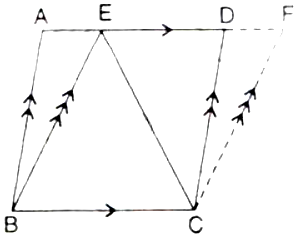
$\text{ABCD}$ and $\text{BCFE}$ are parallelograms. If area of triangle $\text{EBC} = 480 \ cm^2; \text{AB} = 30 \ cm$ and $\text{BC} = 40 \ cm$.

Calculate :$(i)$ Area of parallelogram $\text{ABCD};(ii)$ Area of the parallelogram $\text{BCFE};(iii)$ Length of altitude from $\text{A}$ on $\text{CD};(iv)$ Area of triangle $\text{ECF}$.
Make $k$ the subject of formula $T=2 \pi \sqrt{\frac{ k ^2+ h ^2}{h g}}$