Question
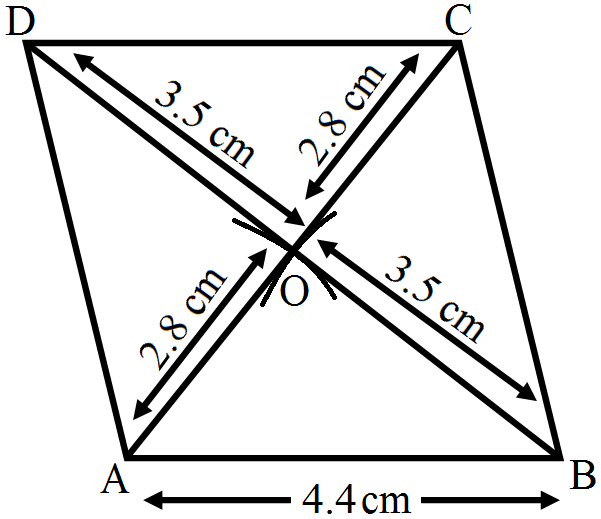
Construct a parallelogram, one of whose sides is $4.4\ cm$ and whose diagonals are $5.6\ cm$ and $7\ cm.$ Measure the other side.
Answer

We know that the diagonals of a parallelogram bisect each other.

Steps of construction:
Step 1: Draw $AB = 4.4\ cm.$
Step 2: With $A$ as the centre and radius $2.8\ cm$, draw an arc.
Step 3: With $B$ as the centre and radius $3.5\ cm,$ draw another arc, cutting the previous arc at point $O.$​​​​​​​
Step 4: Join $OA$ and $OB.$​​​​​​​
Step 5: Produce $OA$ to $C,$ such that $OC = AO.$ Produce $OB $ to $D,$ such that $OB = OD.$​​​​​​​
Step 6: Join $AD, BC,$ and $CD.$ Thus, $ABCD$ is the required parallelogram.
The other side is $4.5\ cm$ in length.

Need a full question paper?

Generate a complete, print-ready paper with questions like this in minutes — across 16+ boards, with answer keys.

Start Generating Free

Similar questions

Express the number appearing in the following statements in standard form.
(i) 1 micron is equal to $\frac{1}{1000000} m$.
(ii) Charge of an electron is 0.00000000000000000016 coulomb.
(iii) Size of a bacteria is 0.0000005 m .
(iv) Size of a plant cell is 0.00001275 m .
(v) Thickness of a thick paper is 0.07 mm .
The area of a trapezium with equal non-parallel sides is $168m^2$. If the lengths of the parallel sides are $36\ m$ and $20\ m$, find the length of the non-parallel sides.
A rectangular water reservoir contains $105m^3$ of water. Find the depth of the water in the reservoir if its base measures $12m$ by $3.5m$.
Construct a quadrilateral $ABCD$ such that $AB = BC = 5.5\ cm CD = 4\ cm , DA = 6.3\ cm $ and $AC = 9.4\  cm $ Measure $BD$.
Ramesh bought two boxes for $Rs.\ 1300$. He sold one box at a profit of $20\%$ and the other box at a loss of $12\%$. If the selling price of both boxes is the same, find the cost price of each box.
Construct a quadrilateral $ABCD$ in which $AB = 3.5\ cm, BC = 3.8\ cm, CD = DA = 4.5\ cm$ and diagonal $BD = 5.6\ cm.$
Solve:
$a^2+ 2a - 3$
Find the product $ 24 x^2(1-2 x) $ and evaluate its value for $x = 3$.
The ratio between the curved surface area and the total surface area of a right circular cylinder is $1 : 2$. Find the volume of the cylinder, if its total surface area is $616cm^2$.
The perimeters of two squares are $40$ and $96$ metres respectively. Find the perimeter of another square equal in area to the sum of the first two squares.