Question
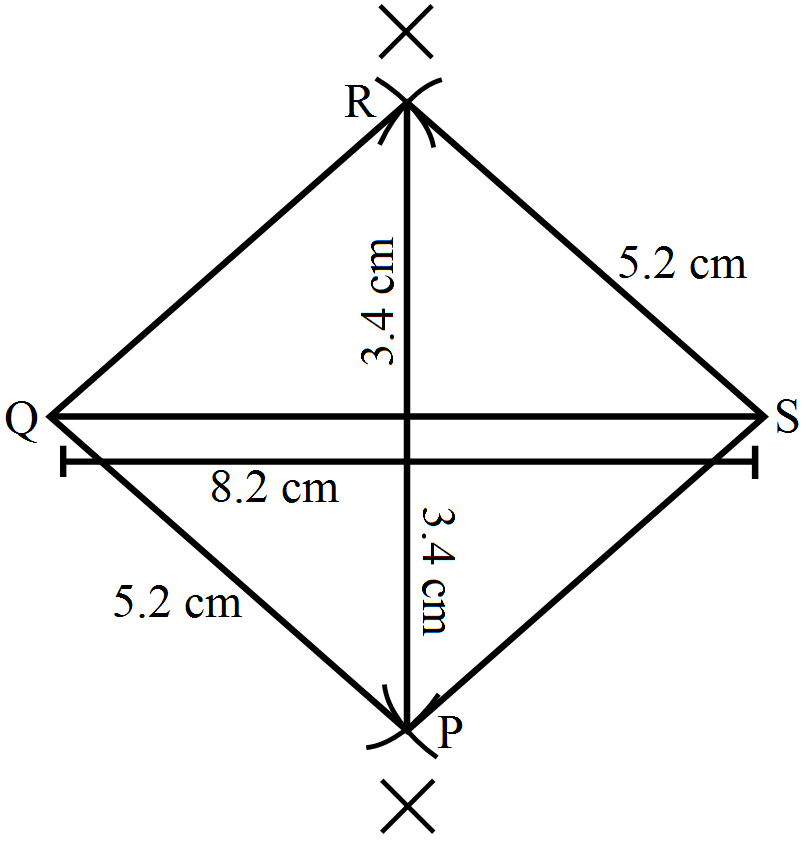
Construct a parallelogram PQRS such that PQ = 5.2cm, PR = 6.8cm and QS = 8.2cm.
Answer


In a parallelogram opposite sides are equal. Thus, we have to construct a quadrilateral PQRS in which PQ = 5.2cm, PR = 6.8cm and QS = 8.2cm.
Steps of construction:
Step I: Draw QS = 8.2cm
Step II: With Q as the centre and radius 5.2cm, draw an arc.
Step III: With S as the centre and radius 5.2cm, draw an arc to intersect the arc drawn in Step II at C.
Step IV: With P as the centre and radius 6.8cm.
Step V: With Q as the centre and radius 5.2cm, draw an arc to intersect the arc drawn in Step IV at A.
Step VI: Join QR, QP, PS and SR.
The quadrilateral PQRS so obtained is the required quadrilateral.

Need a full question paper?

Generate a complete, print-ready paper with questions like this in minutes — across 16+ boards, with answer keys.
Start Generating Free

Similar questions

Write the following numbers in the form of rational indices. : Cube of cube root of 3.
Draw five circles with different radii. Draw a chord and perpendicular from the centre to each chord in each circle. Verify with a divider that the two parts of the chords are equal.
In a convex hexagon, prove that the sum of all interior angles is equal to twice the sum of its exterior angles formed by producing the sides in the same order.
Construct a quadrilateral ABCD in which BC = 7.5cm, AC = AD = 6cm, CD = 5cm and BD = 10cm.
Find the area of the following regular hexagon.

Represent the following data by a pie-diagram:
Items of expenditure
Expenditure
Family A
Family B
Food
4000
6400
Clothing
2500
480
Rent
1500
3200
Education
400
1000
Miscellaneous
1600
600
Total
10000
16000
Ramesh bought two boxes for Rs. 1300. He sold one box at a profit of 20% and the other box at a loss of 12%. If the selling price of both boxes is the same, find the cost price of each box.
Construct the triangles with given measures.
∆DEF: m∠D = 35°, m∠F = 100°, l(DF) = 4.8 cm.
Draw a rhombus EFGH by taking convenient length of side and convenient measure of an angle.
Draw its diagonals and name their point of Intersection as M.
i. Measure the opposite angles of the quadrilateral and angles at the point M.
ii. Measure the two parts of every angle made by the diagonal.
iii. Measure the lengths of both diagonals. Measure the two parts of diagonals made by point M.
Observe the measures. Also observe the measures obtained by your classmates and discuss about them.
Cubes A, B, C having edges 18cm, 24cm and 30cm respectively are melted and moulded into a new cube D. Find the edge of the bigger cube D.