Question
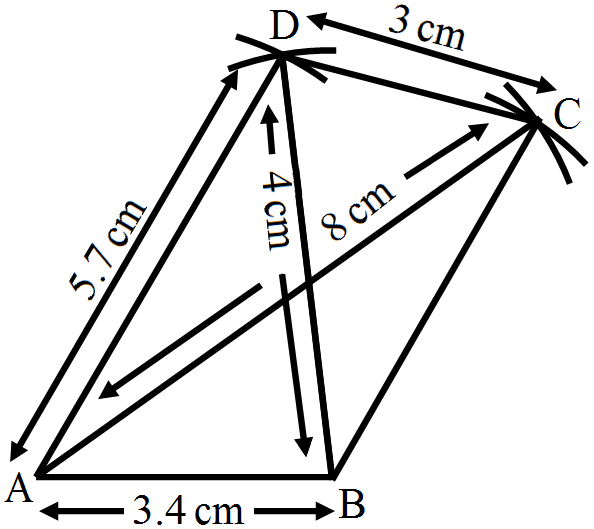
construct a quadrilateral ABCD in which AB = 3.4cm, CD = 3cm, DA = 5.7cm, AC = 8cm and BD = 4cm.

Answer


Steps of construction:
Step 1: Draw AB = 3.4cm.
Step 2: With B as the centre and radius equal to 4cm, draw an arc.
Step 3: With A as the centre and radius equal to 5.7cm, draw another arc, cutting the previous arc at D.
Step 4: Join BD and AD.
Step 5: With A as the centre and radius equal to 8cm, draw an arc.
Step 6: With D as the centre and radius equal to 3cm, draw another arc, cutting the previous arc at C.
Step 7: Join AC, CD and BC.
Thus, ABCD is the required quadrilateral.

Need a full question paper?

Generate a complete, print-ready paper with questions like this in minutes — across 16+ boards, with answer keys.
Start Generating Free

Similar questions

The dimensions of an oil tin are 26cm × 26cm × 45cm. Find the area of the tin sheet required for making 20 such tins. If 1 square metre of the tin sheet costs Rs. 10, find the cost of the tin sheet used for these 20 tins.
The area of the base of a right circular cylinder is $616 cm^2$ and its height is 25 cm . Find the volume of the cylinder.
Arrange the following rational numbers in ascending order:
$\frac{-3}{4},\frac{5}{-12},\frac{-7}{16},\frac{9}{-24}$
Find the ratio between the total surface area of a cylinder to its curved surface area, given that its height and radius are 7.5cm and 3.5cm.
Solve the following equation and also check your result in case:
$0.18(5\text{x}-4)=0.5\text{x}+0.8$
Draw a circle of radius 28mm. Draw any one triangle and draw a trapezium on the graph paper. Find the area of these figures by counting the number of small squares on the graph paper. Verify your answers using formula for area of these figures.Observe that smaller the squares of graph paper, better is the approximation of area.
The total surface area of a hollow cylinder which is open from both sides is 4620 sq.cm, area of base ring is 115.5 sq.cm and height 7cm. Find the thickness of the cylinder.
Arrange the following rational numbers in ascending order:
$\frac{-4}{7},\frac{-9}{14},\frac{13}{-28},\frac{-23}{42}$
Construct ₹PQRS, such that l(PQ) = 3.5 cm, l(QR) = 5.6 cm, l(RS) = 3.5 cm, m∠Q = 110°, m∠R = 70°. If it is given that ₹PQRS is a parallelogram, which of the given information is unnecessary ?
Simplify:
$(2.5 p-1.5 q)^2-(1.5 p-2.5 q)^2$