Question
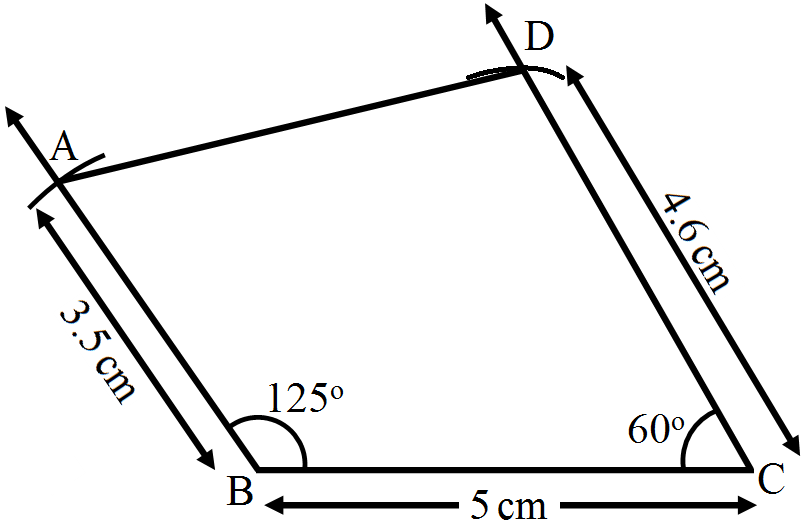
Construct a quadrilateral ABCD in which AB = 3.5cm, BC = 5cm, CD = 4.6cm, $\angle\text{B}=125^\circ$ and $\angle\text{C}=60^\circ.$
Answer


Steps of construction:
Step 1: Draw BC = 5cm.
Step 2: Make $\angle\text{B}=125^\circ$ and $\angle\text{C}=60^\circ.$
Step 3: With B as the centre, draw an arc of 3.5cm. Name that point as A.
Step 4: With C as the centre, draw an arc of 4.6cm. Name that point as D.
Step 5: Join A and D.
Then, ABCD is the required quadrilateral.

Need a full question paper?

Generate a complete, print-ready paper with questions like this in minutes — across 16+ boards, with answer keys.

Start Generating Free

Similar questions

By what number should $\Big(\frac{-2}{3}\Big)^{-3}$ be divided so that the quotient may be $\Big(\frac{4}{27}\Big)^{-2}$?
Construct a parallelogram ABCD in which AB = 4.3cm, AD = 4cm and BD = 6.8cm.
What price should Aslam mark on a pair of shoes which costs him Rs. 1200 so as to gain 12% after allowing a discount of 16%?
Multiply the monomial by the binomial and find the value of $x=-1, y=0.25$ and $z=0.05$ :
$-3 x\left(y^2+z^2\right)$
Construct a frequency table with class-intervals 0-5 (5 not included) of the following marks obtained by a group of 30 students in an examination.
0, 5, 7, 10, 12, 15, 20, 22, 25, 27, 8, 11, 17, 3, 6, 9, 17, 19, 21, 29, 31, 35, 37, 40, 42,45, 49, 4, 50, 16.
6400 workers were employed to construct a river bridge in four years. At the end of the first year, 25% workers were retrenched. At the end of the second year, 25% of those working at that time were retrenched. However, to complete the project in time, the number of workers was increased by 25% at the end of the third year. How many workers were working during the fourth year?
Solve the following equation and verify your answer:
$\frac{2}{3\text{x}}-\frac{3}{2\text{x}}=\frac{1}{12}$
Verify the division algorithm i.e., Dividend = Divisor × Quotient + Remainder, in the following. Also write the quotient and remainder.
Dividend: $4 y^3+8 y+8 y^2+7$
Divisor: $2 y^2-y+1$
Locate the points P(3, 4), Q(1, 0), R(0, 4) and S(4, 1) on a graph sheet and write the coordinates of the points of intersection of line segments PQ and RS.
By what number should the following numbers be multiplied to get a perfect square in each case? Also, find the number whose square is the new number.
2880