Question
Construct a quadrilateral ABCD in which $AB =4.5 cm, BC =5.2 cm, CD =5 cm$, $DA =4.7 cm$ and $\angle ABC =75^{\circ}$.
Answer

self

Need a full question paper?

Generate a complete, print-ready paper with questions like this in minutes — across 16+ boards, with answer keys.

Start Generating Free

Similar questions

Find the volume of a cuboid whose diagonal is $3 \sqrt{29} \ cm$ when its length, breadth and height are in the ratio $2: 3: 4$.
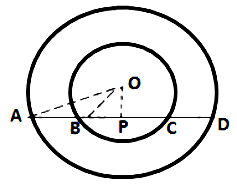
In the following figure, $A D$ is a straight line, $O P \perp A D$ and $O$ is the centre of both circles. If $O A=34 \ cm, O B=20 \ cm$ and $O P=16 \ cm$;find the length of $AB.$
The difference between the compound interest for 1 year, compounded half-yearly and the simple interest for 1 year on a certain sum of money at 10% per annum is ₹ 360. Find the sum.
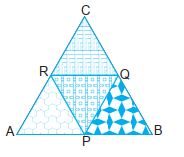
Ankita took part in a Rangoli Competition. She made a beautiful Rangoli in the shape of a triangle ABC as shown. In the triangle, P, Q and R are mid-points of the sides AB, BC and CA respectively. She decorated it by putting a garland along the sides of Delta*PQR The lengths of the sides of the triangle are AB = 20 cm, BC = 26 cm and AC = 24 cm.
Image
Based on the above information, answer the following questions :
Q.1. The length of AP is :
(a) QB (b) QR (c) AR (d) RP
Q.2. The length of PQ is :
(a) 12 cm (b) 13 cm (c) 10 cm (d) 15 cm
Q.3. The length of the garland is :
(a) 30 cm (b) 32 cm (c) 35 cm (d) 40 cm
Q.4. Area of $\triangle PQR$ is :
(a) area of $\triangle ABC$ (b) $\frac{1}{2}$ area of $\triangle ABC$ (c) $\frac{1}{3}$ area of $\triangle ABC$ (d) $\frac{1}{4}$ area of $\triangle ABC$
Q.5. APQR is a :
(a) rectangle (b) parallelogram (c) square (d) rhombus
If $x = (7+4 \sqrt{3})$, find the values of :$\left(x+\frac{1}{x}\right)^2$
Calculate the amount and compound interest to the nearest rupee on $Rs.42000$ for $2$ years at $8\%$ per annum, interest being payable half$-$yearly.
Draw the graph of the lines represented by the equations $5y = 3x + 1$ and $y = 2x + 3$ on the same graph. Find the coordinates of the point where they intersect.
In a right$-$angled $\triangle A B C . \angle  B =90^{\circ}$ and $D$ is the midpoint of $A C$. Prove that$:\ B D=\frac{1}{2} A C$.
The following figure shows a trapezium $\text{ABCD}$ in which $A B$ is parallel to $DC$ and $AD =
BC$.

Prove that:$(i) \angle DAB =\angle CBA;(ii) \angle ADC =\angle BCD;(iii) AC = BD;(iv) OA = OB$ and $OC = OD$.