Question
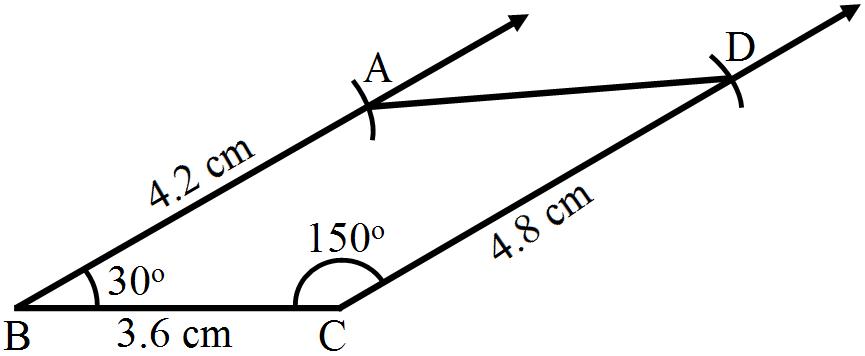
Construct a quadrilateral ABCD, where AB = 4.2cm, BC = 3.6cm, CD = 4.8cm, $\angle\text{B}=30^\circ$ and $\angle\text{C}=150^\circ.$
Answer


Steps of construction:
Step I: Draw BC = 3.6cm.
Step II: Construct $\angle\text{ABC}=30^\circ$ at B.
Step III: With B as the centre and radius 4.2cm, cut off BA = 4.2cm.
Step IV: Construct $\angle\text{BCD}=150^\circ$ at C.
Step V: With C as the centre and radius 4.8cm, cut off CD = 4.8cm.
Step VI: Join AD.
The quadrilateral so obtained is the required quadrilateral.

Need a full question paper?

Generate a complete, print-ready paper with questions like this in minutes — across 16+ boards, with answer keys.

Start Generating Free

Similar questions

Solve the following equation and also check your result in case:
$\frac{9\text{x}+7}{2}-\Big(\text{x}-\frac{\text{x-2}}{7}\Big)=36$
Solve the following equation and verify your answer:
$\frac{\text{y}-(7-8\text{y})}{9\text{y}-(3+4\text{y})}=\frac{2}{3}$
Employees of a company have been categorized according to their religions as given below:
Religions
Hindu
Muslim
Sikh
Christian
Total
Number of Workers
420
300
225
105
1080
Draw a pie-chart to represent the above information.
As shown in the given figure, a student drew ∆ABC using five parallel lines of a notebook. Then he found the centroid G of the triangle. How will you decide whether the location of G he found, is correct.
Image
The data on religion wise division of 1080 workers of a factory are given below:
Religion
Hindu
Muslim
Sikh
Christian
Number of workers
450
270
255
105
Draw a pie chart to represent the above data.
Leonard Euler, discovered an interesting formula regarding the faces, vertices and edges of solid figures.
Count and write the faces, vertices and edges of the following figures and complete the table. From the table verify Euler’s formula, F + V = E + 2.
Image
The angle between the altitudes of a parallelogram through the same vertex of an obtuse angle of the parallelogram is 60°. Find the angles of the parallelogram.
Express product as a monomials and verify the result for $x=1, y=2$:
$\left(-x y^3\right) \times\left(y x^3\right) \times(x y)$
Toshiba bought 100 hens for Rs. 8000 and sold 20 of these at a gain of 5%. At what gain percent she must sell the remaining hens so as to gain 20% on the whole?
A, B and C can reap a field in \(15\frac{3}{4}\) days; B, C and D in 14 days; C, D and A in 18 days; D, A and B in 21 days. In what time can A, B, C and D together reap it?