Question
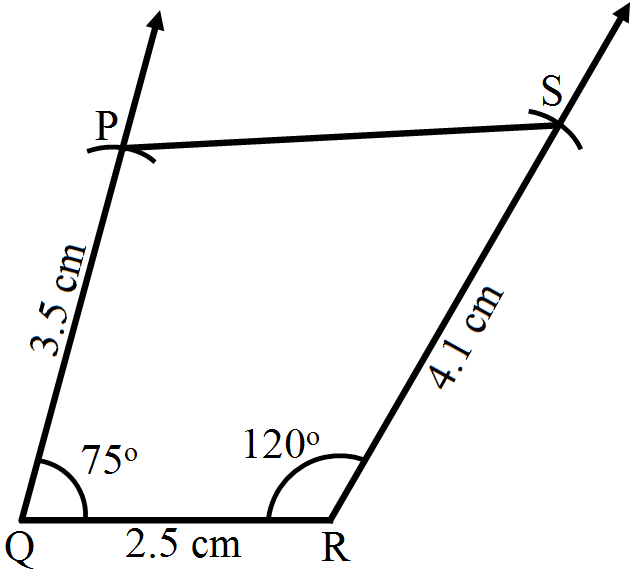
Construct a quadrilateral PQRS, in which PQ = 3.5cm, QR = 2.5cm, RS = 4.1cm, $\angle\text{Q}=75^\circ$ and $\angle\text{R}=120^\circ.$
Answer


Steps of construction:
Step I: Draw QR = 2.5cm.
Step II: Construct $\angle\text{PQr}=75^\circ$ at Q.
Step III: With Q as the centre and radius 3.5cm, cut off QP = 3.5cm.
Step IV: Construct $\angle\text{QRS}=120^\circ$ at R.
Step V: With R as the centre and radius 4.1cm, cut off RS = 4.1cm.
Step VI: Join PS.
The quadrilateral so obtained is the required quadrilateral.

Need a full question paper?

Generate a complete, print-ready paper with questions like this in minutes — across 16+ boards, with answer keys.

Start Generating Free

Similar questions

The following table shows the number of illiterate persons in the age group (10–58 years) in a town. Represent the given data by means of a histogram.
Age group (in years) 10-18 18-26
26-34
34-42
42-50
50-58
Number of illiterate persons 175 325
100
150
250
525
Hint. Take 1 small division = 5 persons.
$\frac{2\text{x}-1}{3}-\frac{6\text{x}-2}{5}=\frac{1}{3}$
It x and y vary inversely, fill in the following blanks:
x
12
16
...
8
...
y
...
6
4
...
0.25
The ages (in years) of 360 patients treated in a hospital on a particular day are given below:
Age (in years)
10-20
20-30
30-40
40-50
50-60
60-70
Number of patiets
90
40
60
20
120
30
Draw a histogram for the given data.
Hint. Take 10 small divisions = 10 patients.
Construct a quadrilateral ABCD given AD = 3.5cm, BC = 2.5cm, CD = 4.1cm, AC = 7.3cm and BD = 3.2cm.
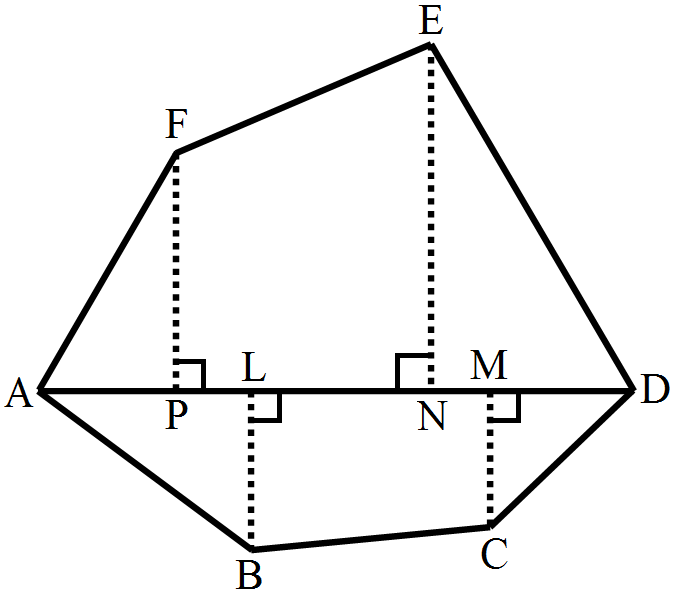
Find the area of hexagon ABCDEF in which $\text{BL}\perp\text{AD},\text{CM}\perp\text{AD},\text{EN}\perp\text{AD}$ such that AP = 6cm, PL = 2cm, LN = 8cm, NM = 2cm, MD = 3cm, FP = 8cm, EN = 12cm, BL = 8cm and CM = 6cm.

Draw a rhombus EFGH by taking convenient length of side and convenient measure of an angle.
Draw its diagonals and name their point of Intersection as M.
i. Measure the opposite angles of the quadrilateral and angles at the point M.
ii. Measure the two parts of every angle made by the diagonal.
iii. Measure the lengths of both diagonals. Measure the two parts of diagonals made by point M.
Observe the measures. Also observe the measures obtained by your classmates and discuss about them.

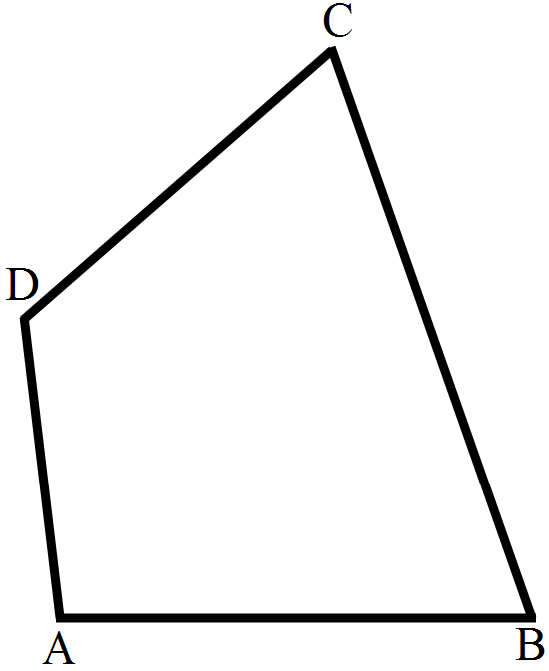
In the figure, ABCD is a quadrilateral.
  1. Name a pair of adjacent sides.
  2. Name a pair of opposite sides.
  3. How many pairs of adjacent sides are there?
  4. How many pairs of Opposite sides are there?
  5. Name a pair of adjacent angles.
  6. Name a pair of opposite angles.
  7. How many pairs of adjacent angles are there?
  8. How many pairs of opposite angles are there?
Various modes of transport used by 1260 students in a given school are given below:
School bus
Private bus
Bicycle
Rickshaw
On foot
350
245
210
175
280
Represent the above data by a pie chart.
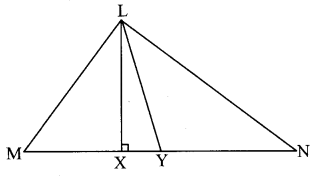
In ∆LMN, __ is an altitude and __ is a median, (write the names of appropriate segments.)
Image