Question
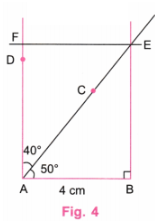
Construct a rectangle in which one of the diagonals divides the opposite angles into 50° and 40°.
Answer

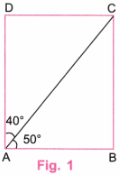
We shall draw a rectangle of the form shown in Fig. 1.
Image
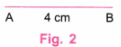
Step 1. Using a ruler, draw a line AB equal to 4 cm, say. (Fig. 2.)
Image
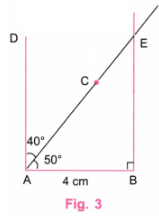
Step 2. Using a protractor, mark dots C and D at angles 50° and 90° (50° + 40°), keeping the central point of the protractor at A. (Fig. 3)
Image
Step 3. Using a protractor, draw a perpendicular line to AB at B and let it intersect the extended line AC at E. (Fig 3)
Step 4. Using a protractor, draw a perpendicular line to BE at E and let it intersect the extended line AD at F. (Fig 4)
Image
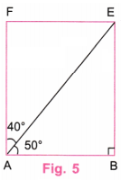
Step 5. Erase the extra lines in Fig. 4. (Fig. 5)
Image
Step 6. Fig. 5 is the required rectangle in which one of the diagonals divides the opposite angles into 50° and 40°.
Need a full question paper?

Generate a complete, print-ready paper with questions like this in minutes — across 16+ boards, with answer keys.

Start Generating Free

Similar questions

Following figures relate the weekly wages $($in $Rs.)$ of $15$ workers in a factory: $300, 250, 200, 250, 200, 150, 350, 200, 250, 200, 150, 300, 150, 200, 250$ Prepare a frequency table
$i.\ $What is the range in wages $($in $Rs.)$?
$ii.\ $How many Workers are getting $Rs. 350$?
$iii.\ $How many of workers are getting the minimum wages?
Match the following:
$(a)$ Straight angle $(i)$ Less than one-fourth a revolution
$(b)$ Right angle $(ii)$ More than half a revolution
$(c)$ Acute angle $(iii)$ Half of a revolution
$(d)$ Obtuse angle $(iv)$ One-fourth a revolution
$(v)$Reflex angle $(v)$Between $\frac{1}{4}$ and $\frac{1}{2}$ of a revolution
  $(vi)$One complete revolution
Draw a line segment of length $6.5\ cm$ and divide it into four equal parts, using ruler and compasses.
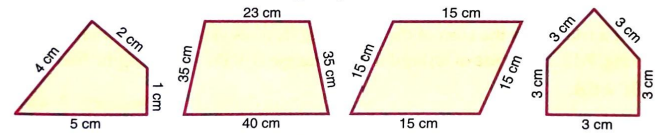
Find the perimeter of each of the following shapes:
Image
If $4, a, a, 36$ are in proportion, then $a =$
Define $(i) FACTOR, \ (ii) MULTIPLE.$ Give five example of each.
Use number line and add the integers: $(-1) + (-7).$
The following data gives the production of food grains (in thousand tones) for some years:
Years
$1995$
$1996$
$1997$
$1998$
$1999$
$2000$
Production (in thousand tonnes)
$120$
$150$
$140$
$180$
$170$
$190$
Represent the above data with the help of a bar graph.
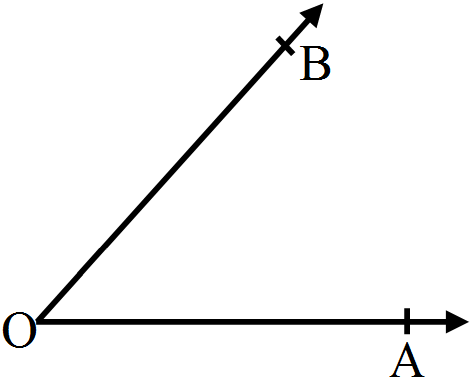
Draw an angle equal to $\triangle\text{AOB},$ given in the adjoining figure.
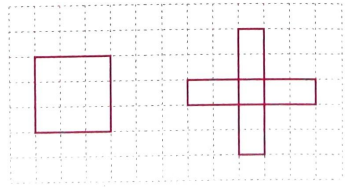
Avneet buys 9 square paving slabs, each with a side of $\frac{1}{2} m$. He lays them in the form of a square.
Image
(i) What is the perimeter of his arrangement?
(ii) Shari does not like his arrangement. She gets him to lay them out like a cross. What is the perimeter of her arrangement?
(iii) Which has greater perimeter?
(iv) Avneet wonders, if there is a way of getting an even greater perimeter. Can you find a wal of doing this? (The paving slabs must meet along complete edges they cannot be broken!