Question
Construct a rectangle PQRS by taking two convenient adjacent sides. Name the point of intersection of diagonals as T. Using divider and ruler, measure the following lengths.
i. lengths of opposite sides, seg QR and seg PS.
ii. lengths of seg PQ and seg SR.
iii. lengths of diagonals PR and QS.
iv. lengths of seg PT and seg TR, which are parts of the diagonal PR.
v. lengths of seg QT and seg TS, which are parts of the diagonal QS.
Observe the measures. Discuss about the measures obtained by your classmates.
Answer

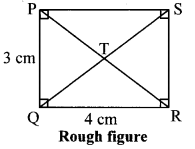
Draw a rectangle PQRS such that, l(PQ) = 3 cm and l(QR) = 4 cm.
Image
Steps of construction :
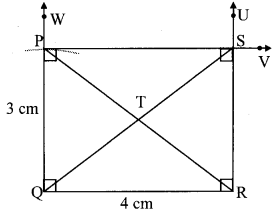
i. As shown in the rough figure, draw seg QR of length 4 cm.
ii. Placing the centre of the protractor at point Q, draw ray QW making an angle of 90° with seg QR.
iii. By taking a distance of 3 cm on the compass and placing it at point Q, draw an arc on ray QW. Name the point as P.
iv. Draw ray PV and ray RU making an angle of 90° with seg PQ and seg QR respectively.
v. Name the point of intersection of ray PV and ray RU as S.
₹PQRS is the required rectangle.
Image
From the figure,
i. l(QR) = l(PS) = 4 cm
ii. l(PQ) = l(SR) = 3 cm
iii. l(PR) = l(QS) = 5 cm
iv. l(PT) = l(TR) = 2.5 cm
v. l(QT) = l(TS) = 2.5 cm

From the above measures, we can say that for any rectangle,
i. Opposite sides are congruent.
ii. Diagonals are congruent.
iii. Diagonals bisect each other.

Need a full question paper?

Generate a complete, print-ready paper with questions like this in minutes — across 16+ boards, with answer keys.

Start Generating Free

Similar questions

What is the smallest number by which 8192 must be divided so that quotient is a perfect cube? Also, find the cube root of the quotient so obtained.
Study the table given below and draw a line graph for it.
Side of the square (in cm)
2
3
4
5
6
Area (in $cm^2$)
4
9
16
25
36
Is the graph drawn, a linear graph?
The weekly wages (in Rs.) of 30 workers in a factory are given:
830, 835, 890, 810, 835, 836, 869, 845, 898, 890, 820, 860, 832, 833, 855, 845, 804, 808, 812, 840, 885, 835, 835, 836, 878, 840, 868, 890, 806, 840
Mark a frequency table with intervals as 800-810, 810-820 and so on, using tally marks. Also, draw a histogram and answer the following questions:
  1. Which group has the maximum number of workers?
  2. How many workers earn Rs. 850 and more?
  3. How many workers earn less than Rs. 850?
In the given figure, line p || line q, line l || line m. Find measures of ∠a, ∠b and ∠c, using the measures of given angles. Justify your answers.
Image
Construct a rhombus with side 6cm and one diagonal 8cm. Measure the other diagonal.
The area of a square field is $5184 cm^2$. A rectangular field, whose length is twice its breadth has its perimeter equal to the perimeter of the square field. Find the area of the rectangular field.
A sum of Rs 800 is in the form of denominations of Rs 10 and Rs 20. If the total number of notes be 50, find the number of notes of each type.
Find the length of diagonal of a square with side 8 cm.
A rectangular grassy plot is 112m long and 78m broad. It has a gravel path 2.5m wide all around it on the side. Find the area of the path and the cost of constructing it at Rs. 4.50 per square metre.
Observe the following pattern,
$1^2=\frac{1}{6}\big[1\times(1+1)\times(2\times1+1)\big]$
$1^2+2^2=\frac{1}{6}\big[2\times(2+1)\times(2\times2+1)\big]$
$1^2+2^2+3^2=\frac{1}{6}\big[3\times(3+1)\times(2\times3+1)\big]$
$1^2+2^2+3^2+4^2=\frac{1}{6}\big[4\times(4+1)\times(2\times4+1)\big]$
and find the values of each of the following:
  1. $1^2+2^2+3^2+4^2+\ .....\ +10^2$
  2. $5^2+6^2+7^2+8^2+9^2+10^2+11^2+12^2$