Question
Construct a square $\text{ABCD},$ when: Perimeter $= 24 \ cm.$

Answer

The perimeter of a square
$P=4 a$
Where $a$ is the length of each side
We have Perimeter $=24 \ cm$
Therefore,
$24=4 a$
$ 4=6$
Therefore the sides of the squares are of length $6 \ cm$.

Steps:
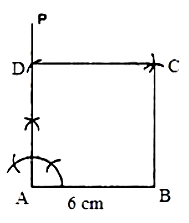
$1$. Draw a line segment $A b=6 \ cm$.
$2$. Draw $A P \perp A B$.
$3$. From $A P$ cut off $A D=6 \ cm$.
$4$. With $B$ as a center and radius, $6 \ cm$ draw an arc.
$5$. With $D$ as center and radius, $6 \ cm$ draw another arc cutting the former arc at $C$.
$6$. Join $B C$ and $C D$.
$\text{ABCD}$ is the required square.

Need a full question paper?

Generate a complete, print-ready paper with questions like this in minutes — across 16+ boards, with answer keys.
Start Generating Free

Similar questions

A hollow square$-$shaped tube open at both ends is made of iron. The internal square is of $5 \ cm$ side and the length of the tube is $8 \ cm$. There are $192 ~cm^3$ of iron in this tube. Find its thickness.
The wheel of a car makes $10$ revolutions per second. If its diameter is $70\ cm,$ find the speed of the car in $km$ per $hr.$
The length of a rectangular field is thrice of its width. If the perimeter of this field is $1.6\ km$, find its area in $sq.m.$
The cost of a machine depreciated by $Rs. 4,000$ during the first year and by $Rs. 3,600$ during the second year. Calculate :
  1. The rate of depreciation.
  2. The original cost of the machine.
  3. Its cost at the end of the third year.
Evaluate the following: $\frac{3 \sin ^2 40^{\circ}}{4 \cos ^2 50^{\circ}}-\frac{\operatorname{cosec}^2 28^{\circ}}{4 \sec ^2 62^{\circ}}+\frac{\cos 10^{\circ} \cos 25^{\circ} \cos 45^{\circ} \operatorname{cosec} 80^{\circ}}{2 \sin 15^{\circ} \sin 25^{\circ} \sin 45^{\circ} \sin 65^{\circ} \sec 75^{\circ}}$
Simplify the following:$2 \log 5+\log 8-\frac{1}{2} \log 4$
Construct a parallelogram $\text{ABCD},$ when:$AB = 5.8 \ cm,$ diagonal $AC = 8.2 \ cm$ and diagonal $BD = 6.2 \ cm.$
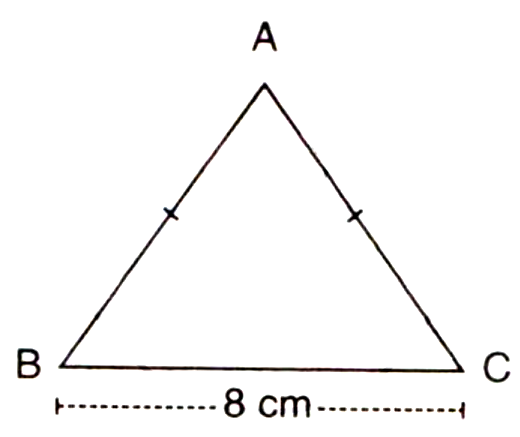
In the figure given below$, \text{ABC}$ is an isosceles triangle with $BC = 8 \ cm$ and $AB = AC = 5 \ cm$. Find:$(i)\sin B;(ii)\tan C;(iii)\sin^2 B + \cos^2B;(iv)\tan C - \cot B$
$AM$ and $DN$ are the altitudes of two similar triangles $\text{ABC}$ and $\text{DEF}$. Prove that: $AM : DN = AB : DE.$
Simplify:$\left(a+\frac{1}{a}\right)^3-\left(a-\frac{1}{a}\right)^3$