Question

Construct a triangle BPC given BC = 5 cm, BP = 4 cm and .

i) complete the rectangle ABCD such that:
a) P is equidistant from AB and BCV
b) P is equidistant from C and D.
ii) Measure and record the length of AB.
Answer


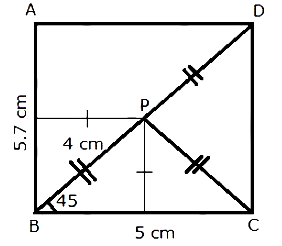
1. i) Steps of Construction:
1) Draw a line segment BC = 5 cm
2) B as centre and radius 4 cm draw an arc at an angle of 45 degrees from BC.
3) Join PC.
4) B and C as centers, draw two perpendiculars to BC.
5) P as centre and radius PC, cut an arc on the perpendicular on C at D.
6) D as centre, draw a line parallel to BC which intersects the perpendicular on B at A.
ABCD is the required rectangle such that P is equidistant from AB and BC (since BD is angle bisector of angle B) as well as C and D.
5. ii) On measuring AB = 5.7 cm

Need a full question paper?

Generate a complete, print-ready paper with questions like this in minutes — across 16+ boards, with answer keys.

Start Generating Free

Similar questions

The mean of the following distribution in $52$ and the frequency of class interval $30-40\  'f\ '$ find $f$
$C.I$ $10-20$ $20-30$ $30-40$ $40-50$ $50-60$ $60-70$ $70-80$
$freq$ $5$ $3$ $f $ $7$ $2$ $6$ $13$
Find the value of the constant a and b, if $(x – 2)$ and $(x + 3)$ are both factors of expression $x^3 + ax^2 + bx - 12.$
Find the length of the chord of a circle in the following when:
Radius is $1. 7\ cm$ and the distance from the centre is $1.5 \ cm$
Draw a histogram for the following distribution and estimate the mode: 
I.Q. Score 80-100 100-120 120-140 140-160 160-180 180-200
No. of Students 6 9 16 13 4 2
A fast train takes $3$ hours less than a slow train for a journey of $600\ kms.$ If the speed of the slow train is $1$ Okm/ hr less than the fast train, find the speed of the fast train.
In the given figure, AB is a diameter of the circle with centre O. DO is parallel to CB and ∠DCB = 120°.
Calculate : ∠ADC
Also, show that the Δ AOD is an equilateral triangle.
The diagonals of a cyclic quadrilateral are at right angles. Prove that the perpendicular from the point of their intersection on any side when produced backward bisects the opposite side.
Solve for $x: \left(x+\frac{1}{x}\right)^2-\frac{3}{2}\left(x-\frac{1}{x}\right)-4=0$
Three vertices of a parallelogram ABCD taken in order are $A(3,6),B(5,10)$ and $C(3,2),$ find :
$(1)$ the co-ordinates of the fourth vertex D.
$(2)$ Length of diagonal BD.
$(3)$ equation of side AB of the parallelogram ABCD
Find two numbers in the ratio of 8 : 7 such that when each is decreased by , they are in the ratio 11 : 9.