Question
Construct ₹LMNO such that
l(LM) = l(LO) = 6 cm,
l(ON) = l(NM) = 4.5 cm, l(OM) = 7.5 cm.

Answer

Get the step-by-step solution for this question inside the Vidyadip app.

Get the answer in the app

Need a full question paper?

Generate a complete, print-ready paper with questions like this in minutes — across 16+ boards, with answer keys.

Start Generating Free

Similar questions

Solve the following equation and verify your answer:
$\frac{3\text{x}+5}{2\text{x}+7}=4$
A rectangular grassy plot is 112m long and 78m broad. It has a gravel path 2.5m wide all around it on the side. Find the area of the path and the cost of constructing it at Rs. 4.50 per square metre.
Using Euler's formula find the unknown:
Faces
?
5
20
Vertices
6
?
12
Edges
12
9
?
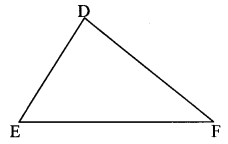
Write answers to the following questions referring to the given figure.
Image

  1. Which is the angle opposite to the side DE?
  2. Which is the side opposite to ∠E?
  3. Which angle is included by side DE and side DF?
  4. Which side is included by ∠E and ∠F?
  5. State the angles adjacent to side DE.


ABC is a right-angled triangle and O is the mid-point of the side opposite to the right angle. Explain why O is equidistant from A, B and C.
x varies inversely as y, when x = 15 then y = 10, if x = 20, then y = ?
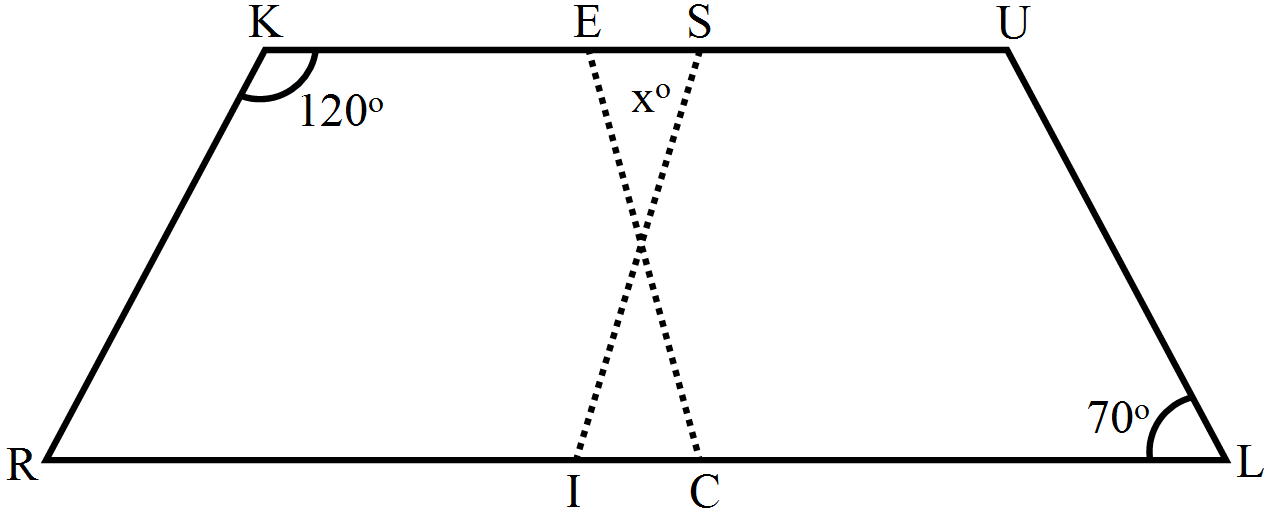
In the following figure RISK and CLUE are parallelograms. Find the measure of x.
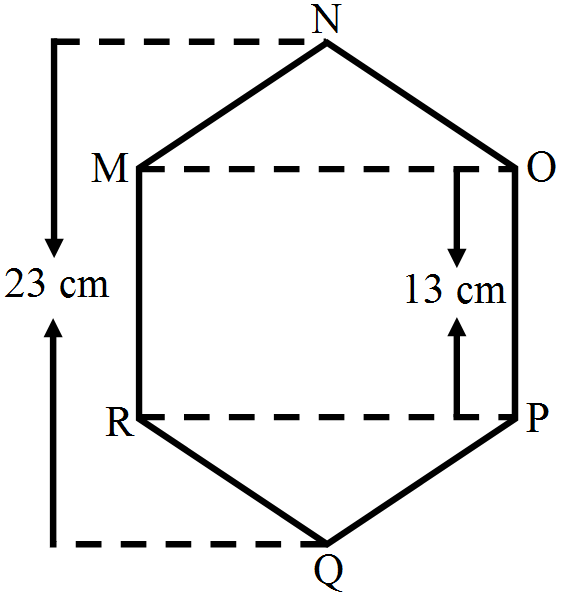
Find the area of the following regular hexagon.

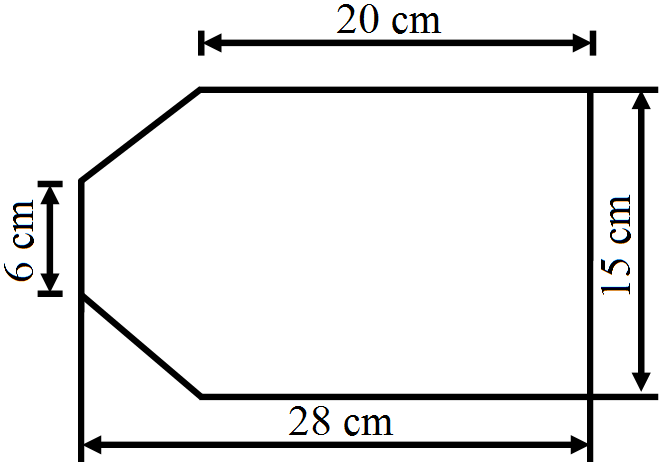
Find the area enclosed by the following figures as the sum of the areas of a rectangle and a trapezium:
Observe the following pattern,
$1^2=\frac{1}{6}\big[1\times(1+1)\times(2\times1+1)\big]$
$1^2+2^2=\frac{1}{6}\big[2\times(2+1)\times(2\times2+1)\big]$
$1^2+2^2+3^2=\frac{1}{6}\big[3\times(3+1)\times(2\times3+1)\big]$
$1^2+2^2+3^2+4^2=\frac{1}{6}\big[4\times(4+1)\times(2\times4+1)\big]$
and find the values of each of the following:
  1. $1^2+2^2+3^2+4^2+\ .....\ +10^2$
  2. $5^2+6^2+7^2+8^2+9^2+10^2+11^2+12^2$