Question
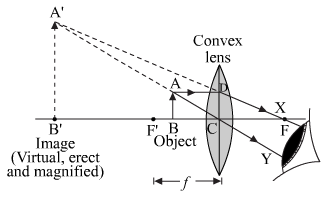
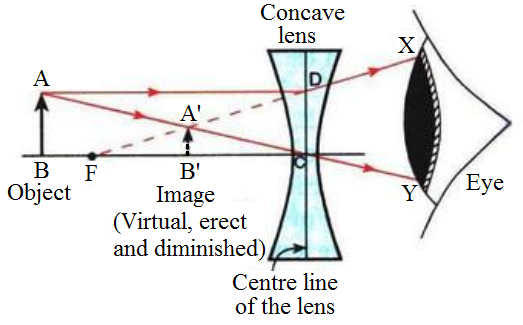
Construct ray diagrams to illustrate the formation of a virtual image using:
  1. A converging lens, and.
  2. A diverging lens.

Answer

  1.  
  1.  

Need a full question paper?

Generate a complete, print-ready paper with questions like this in minutes — across 16+ boards, with answer keys.

Start Generating Free

Similar questions

A food chain occurring in the sea which provides food for many people can be written as:
phytoplankton → zooplankton → X → Y
  1. Name one phytoplankton.
  2. Name two zooplanktons.
  3. What could be X?
  4. Name the organism which Y could be.
  5. Which organism in the above food chain is a (i) primary consumer, and (ii) tertiary consumer?
(i) "Keerthi thinks that Substitution reaction occurs in saturated Hydrocarbons, on the contrary Krishi thinks, it occurs in unsaturated Hydrocarbons." Justify with valid reasoning whose thinking is correct.
(ii) "Methane and Propane and their Isomers are used as fuels" Comment. Draw the electron dot structure of the immediate lower homologue of Propane. Give any two characteristics of homologues of a given homologous series.
(iii) A mixture of oxygen and ethyne is burnt for welding. Can you predict why a mixture of ethyne and air is not used?
What is an electric motor? With the help of a labelled diagram, describe the working of a simple electric motor.
  1. Distinguish between ‘roasting’ and ‘calcination’. Which of these two is used for sulphide ores and why?
  2. Write a chemical equation to illustrate the use of aluminium for joining cracked railway lines.
  3. Name the anode, the cathode and the electrolyte used in the electrolytic refining of impure copper.
Consider the following organic compounds:
$CH _3 OH , C _2 H _5 OH , CH _3 COCH _3, CH _3 COOH , C _2 H _5 COOH , C _4 H _9 COOC _2 H _5, CH _4, C _2 H _6, CH _3 CHO , HCHO$
Out of these compounds:
a. Which compound is most likely to be sweet-smelling?
b. Which compound on treatment with conc. $H _2 SO _4$ at $170^{\circ} C$ forms an alkene?
c. Which compound on repeated chlorination forms chloroform?
d. Which compound is added to alcohol to denature it?
e. Which compound is a constituent of vinegar?
f. Which compound is used to sterilise wounds and syringes?
Explain tissue culture technique. In which area this technique is finding its application?
An electric bulb of resistance $20 Ω$ and a resistance wire of $4 Ω $are connected in series with a 6V battery. Draw the circuit diagram and calculate:
  1. Total resistance of the circuit.
  2. Current through the circuit.
  3. Potential difference across the electric bulb.
  4. Potential difference across the resistance wire.
The organisms A, B and C can obtain their food in three different ways. Organism A derives its food from the body of another living organism which is called its D, without killing it. The organism B takes in the solid food by the process of ingestion, digests a part of this food and throws out undigested food in the process called E. The organism C obtains its food from dead and decaying plants.
  1. What is the mode of nutrition of (i) organism A (ii) organism B, and (iii) organism C?
  2. What is the organism like D called?
  3. Name the process E.
  4. Give one example each of organisms like A, B and C.
  5. What is the general name of three modes of nutrition exhibited by organisms A, B and C?
Suppose you have three concave mirrors A, B and C of focal lengths 10cm, 15cm and 20cm. For each concave mirror, you perform the experiment of image formation for three values of object distance of 10cm, 20cm and 30cm. Giving reason answer the following:
  1. For the three object distances, identify the mirror/ mirrors which will form an image of magnification - 1.
  2. Out of the three mirrors identify the mirror which would be preferred to be used for shaving purposes/ makeup.
  3. For the mirror B draw, ray diagram for image formation for object distances 10cm and 20cm.
What are the scientific names for the following receptors in animals?
  1. Receptors for light.
  2. Receptors for heat.
  3. Receptors for sound.
  4. Receptors for smell.
  5. Receptors for taste.