Question
Construct the following indices by taking 2015 as the base:
  1. Simple Aggregative Price Index.
  2. Index of Average of Price Relatives.
Items
A
B
C
D
E
Prices ₹ (2015)
6
2
4
10
8
Prices ₹ (2016)
10
2
6
12
12
Prices ₹ (2017)
15
3
8
14
16

Answer

Items
$p_0$
$p_1$
$p_2$
$\frac{\text{p}_1}{\text{p}_0}\times100$
$\frac{\text{p}_2}{\text{p}_0}\times100$
A
6
10
15
166.66
250
B
2
2
3
1000.00
150
C
4
6
8
150.00
200
D
10
12
14
120.00
140
E
8
12
16
150.00
200
 
$\Sigma\text{p}_0=30$
$\Sigma\text{p}_1=42$
$\Sigma\text{p}_2=56$
$\Sigma\Big(\frac{\text{p}_1}{\text{p}_0}\times100\Big)=686.66$
$\Sigma\Big(\frac{\text{p}_2}{\text{p}_0}\times100\Big)=940$
  1. Simple Aggregative Price Index:
$\text{p}_{01}=\frac{\Sigma\text{p}_1}{\Sigma\text{p}_0}\times100$

$=\frac{42}{30}\times100=140$ (For 2016)

$\text{p}_{02}=\frac{\Sigma\text{p}_2}{\Sigma\text{p}_0}\times100$

$=\frac{56}{30}\times100=186.66$ (For 2017)
  1. Index of Average of price Relatives:
$\text{P}_{01}=\frac{\Sigma\Big(\frac{\text{p}_1}{\text{p}_0}\times100\Big)}{\text{N}}=\frac{686.66}{5}=137.33$

$\text{P}_{02}=\frac{\Sigma\Big(\frac{\text{p}_2}{\text{p}_0}\times100\Big)}{\text{N}}=\frac{940}{5}=188$

Need a full question paper?

Generate a complete, print-ready paper with questions like this in minutes — across 16+ boards, with answer keys.

Start Generating Free

Similar questions

Find the standard deviation by the step deviation method.
Class lnterval: $0-10$ $10-20$ $20-30$ $30-40$ $40-50$ $50-60$
Frequency (f): $16$ $12$ $10$ $15$ $12$ $8$
Calculate standard deviation from the following data using step deviation method:
Marks: 0-10 10-20 20-30 30-40 40-50
No. of Students: 4 3 6 4 2
Explain the following:
(i) 'Free entry and exit' feature of perfect competition.
(ii) 'Perfect knowledge' feature of perfect competition.
Following are the marks obtained by 100 students in Economics. Calculate the average marks by using:
  1. Direct method.
  2. Assumed mean method (take 35 as Assumed mean).
  3. Step-deviation method.
Marks
0-10
10-20
20-30
30-40
40-50
50-60
No. of Students
5
10
25
30
20
10
Mailing questionnaire and schedule filled by enumerators are suitable for certain specific cases. Enumerate those cases.
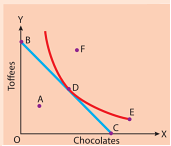
Rohan is choosing how to allocate this spending between chocolates and toffees. The figure alongside shows his budget line and indifference curve. Identify the point as mentioned in the diagram and match it with the appropriate statement given below:
(i) The point at which Rohan maximises his satisfaction.
(ii) The point at which he buys only chocolates and no toffees.
(iii) A consumption bundle which would not exhaust his budget for these goods.
(iv) A point yielding the same satisfaction as at 'D' but which Rohan's budget can't afford.
(v) The point at which he buys only toffees and no chocolates.
(vi) A consumption bundle preferred to point 'D' but which Rohan can't afford.
Image
Explain the concept and uses of index numbers.
Use the data in Table 3.2 that relate to monthly household expenditure (in ₹) on food of 50 households and:
  1. Obtain the range of monthly household expenditure on food.
  2. Divide the range into appropriate number of class intervals and obtain the frequency distribution of expenditure.
  3. Find the number of households whose monthly expenditure on food is:
  1. Less than ₹ 2000
  2. More than ₹ 3000
  3. Between ₹ 1500 and ₹ 2500
Which of the following methods give better results and why?
  1. Census.
  2. Sample.
Gross profits are maximised only when a firm's MC curve cuts MR curve from below. Explain diagrammatically.