Question
‘Controlling is a systematic process involving a series of steps'. Explain.

Answer

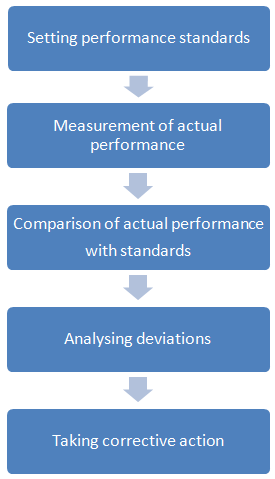
Steps in the process of controlling:
  1. Setting Performance Standards: The first step in the controlling process is setting up of performance standards. Standards are the criteria against which actual performance would be measured. Thus, standards serve as benchmarks towards which an organisation strives to work
  2. Measurement of Actual Performance: Once performance standards are set, the next step is measurement of actual performance. Performance should be measured in an objective and reliable manner. There are several techniques for measurement of performance. These include personal observation, sample checking, performance reports, etc.
  3. Comparing Actual Performance with Standards: This step involves comparison of actual performance with the standard. Such comparison will reveal the deviation between actual and desired results. Comparison becomes easier when standards are set in quantitative terms
  4. Analysing Deviations: Some deviation in performance can be expected in all activities. It is, therefore, important to determine the acceptable range of deviations. Also, deviations in key areas of business need to be attended more urgently as compared to deviations in certain insignificant areas. Critical point control and management by exception should be used by a manager in this regard.
  5. Taking Corrective Action: The final step in the controlling process is taking corrective action. No corrective action is required when the deviations are within acceptable limits. However, when the deviations go beyond the acceptable range, especially in the important areas, it demands immediate managerial attention so that deviations do not occur again and standards are accomplished.
​​​​​​​

Need a full question paper?

Generate a complete, print-ready paper with questions like this in minutes — across 16+ boards, with answer keys.

Start Generating Free

Similar questions

You are a Finance Manager of a newly established company. The Directors have asked you to determine the amount of Fixed Capital requirement for the company. Explain any four factors that you will consider while determining the fixed capital requirement for the company.
What is marketing mix? What are it main elements? Explain.
‘It is necessary that goods and services must be made available to the customer at the right place, in right quantity and at the right time’.
Explain the components of this element.
In an environment of rising petroleum prices and a large middle class population in India. KV Motors Ltd. recognized the need for small cars in India. It created a product far superior than their competitors not only in terms of quality but also in terms of overall driving experience. It soon became the leader in the small car market. As the Indian government was encouraging foreign investment, MNCs having a big name in car manufacturing entered the Indian market.
KV Motors further expanded its service network and quality creating an entry barrier for the competitors. It depicted its strengths through various brand-building activities. As a result, the market share of KV Motors is refusing to go down in spite of all major automakers as its competitors.
  1. Identify the economic reforms highlighted in the above case.
  2. Quoting the lines, explain any two points of importance of Business Environment being highlighted in the above case.
What is meant by ‘Formal Organisation’? State any two advantages and any two limitations of ‘Formal Organisation’.
Leena has been appointed as the Operations Manager in a small trading company dealing in garments, with growing online sales. The company has recently rented space in a warehouse to store garments and mail out orders. In order to take over the responsibilities of order fulfilment, Leena promotes an associate, Kushagra to the post of Inventory and Order fulfilment Supervisor. Kushagra has been given the task to assess whether it is best to process orders as they come in or let them accumulate and then to process them in batches. He concludes that accumulating and then processing them in batches is the best way of fulfilling orders, in order to minimise cost and maximise customer satisfaction.
Through several readings Leena finds that the standard time taken from the placement of order to the delivery of garments for a batch of 100 pieces is 72 hours. This helped her to determine the labour cost.
On the basis of the understanding of concepts of scientific management, identify and explain the techniques used by Leena and Kushagra to improve the performance of the employees.
What are the steps taken by management in the planning process?
'Explain any four characteristics of 'principles of management.'
Explain, in brief, any five types of plans.
“Zero Defect Zero Effect” is a slogan coined by the Prime Minister of India, Narendra Modi, with reference to the Make in India initiative launched by the government. The slogan reflects the efficiency of production processes, i.e., the products have no defects and the process through which the product is made has zero adverse environmental and ecological effects. The ZED model aims to make India the manufacturing hub of the world and prevent the products developed in India from being rejected by the global market. Moreover, before the initiative was launched, the limits of foreign direct investment in various sectors had been relaxed. The application for licences was made available online and the validity of licences was increased to three years.
By quoting lines, identify the major components of New Economic Policy of 1991 that are being referred to in the paragraph.