Question
Convert 1 Joule of energy into CGS system.

Answer

 The unit of energy is SI system is Joule and that is in the CGS system is erg.
Dimensional formula of energy $=\left[ M ^1 L^2 T^{-2}\right]$
Here, $a=1, b=2, c=-2$
S.I. System
$M _1=1 kg$
$L _1=1 m$
$T _1=1 s$
$n _1=1$ Joule
C.G.S. System
$M _2=1 gm$
$L _2=1 cm$
$T _2=1 s$
$n _2=$ ?
$\begin{aligned}
n_2 & =n_1\left[\frac{M_1}{M_2}\right]^a\left[\frac{L_1}{L_2}\right]^b\left[\frac{T_1}{T_2}\right]^c \\
& =1\left[\frac{1 kg}{1 g}\right]^1\left[\frac{1 m}{1 cm}\right]^2\left[\frac{1 s}{1 s}\right]^{-2} \\
& =1\left[\frac{1000 g}{1 g}\right]^1\left[\frac{100 cm}{1 cm}\right]^2\left[\frac{1 s}{1 s}\right]^{-2} \\
& =1 \times 10^3 \times\left(10^2\right)^2=10^3 \times 10^4=10^7
\end{aligned}$
Hence, 1 Joule $=10^7$ erg.

Need a full question paper?

Generate a complete, print-ready paper with questions like this in minutes — across 16+ boards, with answer keys.
Start Generating Free

Similar questions

What is the acceleration due to gravity at the bottom of a sea 30km deep taking radius of the earth as 6.3 × 10km?
A spacecraft consumes more fuel in going from earth to moon than it does on the return trip. Comment on this.
A small steel ball of radius $r$ is allowed to fall under gravity through a column of a viscous liquid of coefficient of viscosity $\eta$. After some time the velocity of the body attains a constant value $v _{ T }$. The terminal velocity depends upon (i) the weight of the ball mg (ii) the coefficient of viscosity $\eta$ and (iii) the radius of the ball r. By the method of dimensions, determine the relation expressing terminal velocity.
Can a room be cooled by leaving the door of an electric refrigerator open?
A circular racetrack of radius 300 m is banked at an angle of 15°. If the coefficient of friction between the wheels of a race-car and the road is 0.2, what is the (a) optimum speed of the racecar to avoid wear and tear on its tyres, and (b) maximum permissible speed to avoid slipping ?
An object whose volume is $100 cm^3$ is completely immersed in water. Find the buoyant force on the object.
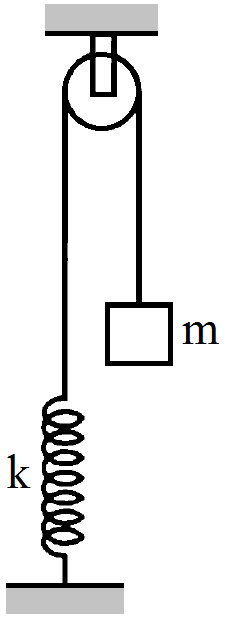
Consider the situation shown in figure. Initially the spring is unstretched when the system is released from rest. Assuming no friction in the pulley, find the maximum elongation of the spring.
The friction force of air on an object moving in air is directly proportional to the velocity of the object, what will be the dimension of constant of proportionality (b)?
A copper wire of diameter 1.6 mm carries 20A. Find the maximum magnitude of the magnetic field $\overrightarrow{\text{B}}$ due to this current.
A wire of length 2.5m has a percentage strain of 0.012% under a tensile force. Determine the extension in the wire.