Question
Convert:
Methane into chloroform

Answer

Methane into chloroform
$CH_4+Cl_2 → CH_3Cl+HCl$
$CH_3Cl+Cl_2 → CH_2Cl_2+HCl$
$CH_2Cl_2+Cl_2 → CHCl_3+HCl$

Need a full question paper?

Generate a complete, print-ready paper with questions like this in minutes — across 16+ boards, with answer keys.
Start Generating Free

Similar questions

Explain the following briefly:
Sodium chloride dissolves in water but carbon tetra chloride is insoluble in water.
What mass of copper hydroxide is precipitated by using $200 gm$ of sodium hydroxide?
$2 NaOH + CuSO _4 \longrightarrow Na _2 SO _4+ Cu ( OH )_2 \downarrow $
${[ Cu =64, Na =23, S =32, H =1]}$

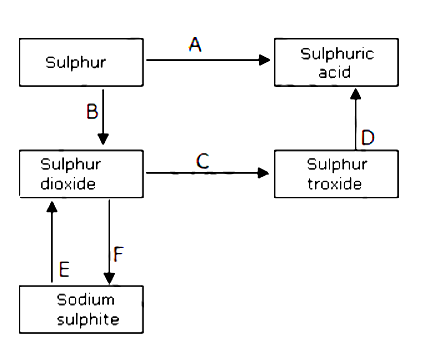
(i) Name the catalyst which helps in the conversion of sulphur dioxide to sulphur trioxide in step C.
(ii) In the contact process for the manufacture of sulphuric acid, sulphur trioxide is not converted to sulphuric acid by reacting it with water. Instead a two-step procedure is used. Write the equations for the two steps involved in D.
(iii) What type of substance will liberate sulphur dioxide from sodium sulphite in step E?
(iv) Write the equation for the reaction by which sulphur dioxide is converted to sodium sulphite in step F ?
Draw the structure of isomers of butane and write their IUPAC names.
Comment on the statement that- "All ores are minerals but all minerals are not ores".
A student puts his signature with graphite pencil. If the mass of carbon in the signature is $10^{-12} g$. Calculate the number of carbon atoms in the signature.
Write equations for the laboratory preparation of :
(i) Methane from sodium ethanoate.
(ii) Ethene from ethanol.
(iii) Ethyne from calcium carbide.
The following questions refer to one mole of chlorine gas.
(a) What is the volume occupied by this gas at S.T.P.?
(b) What will happen to the volume of gas, if pressure is doubled?
(c) What volume will it occupy at $273^{\circ} C$ ?
(d) If the relative atomic mass of chlorine is 35.5, what will be the mass of 1 mole of chlorine gas?
By giving four examples in each case, define or explain the terms (a) strong electrolyte (b) weak electrolyte.
Using Sodium hydroxide solution, how would you distinguish: Ammonium sulphate from sodium sulphate.