MCQ
Convex lens is not used in:
  • A
    Simple microscope
  • B
    Spectacles
  • C
    Telescope
  • Flood lights

Answer

Correct option: D.
Flood lights

Convex lens always converges the parallel rays but in flood lights, we want to diverge the incident rays so as to light up more area. Thus we use a diverging lens i.e. a concave lens. Thus a convex lens is not used in flood lights.

Need a full question paper?

Generate a complete, print-ready paper with questions like this in minutes — across 16+ boards, with answer keys.
Start Generating Free

Similar questions

In a transformer, the number of turns in primary and secondary are $500$ and $2000$ respectively. If current in primary is $48\,A$ , the current in the secondary is......$A$
Calculate the amount of charge flowing in $2$ minutes in a wire of resistance $10$ $\Omega$ when a potential difference of $20\,V$ is applied between its ends ............ $C$
Anti-nodal curves represent the points joining:
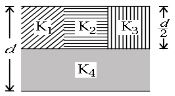
A parallel-plate capacitor of area $A,$ plate separation $d$ and capacitance $C$ is filled with four dielectric materials having dielectric constants $K_1,K_2,K_3$ and $K_4$ as shown in the figure. If a single dielectric material is to be used to have the same capacitance $C$ in this capacitor, then its dielectric constant $K$ is given by 
In an adiabatic process on a gas with $\gamma=1.4,$ the pressure is increased by 0.5%. The volume decreases by about:
A radioactive substance emits
A proton is about 1840 times heavier than an electron. When it is accelerated by a potential difference of 1 kV, its kinetic energy will be:
Two coils of self inductance $100\,mH$ and $400\,mH$ are placed very close to each other. Find the maximum mutual inductance between the two when $8\,A$ current passes through them.......$mH$
Choose the correct answer from alternatives given. If $\overrightarrow{\text{E}}$ and $\overrightarrow{\text{B}}$ represent electric and magnetic field vectors of an electromagnetic wave, the direction of propagation of the wave is along.
The current in a coil of $0.4\ mH$ coil increases by $250\ mA$ in $0.1$ seconds. The induced emf will be:-