Question
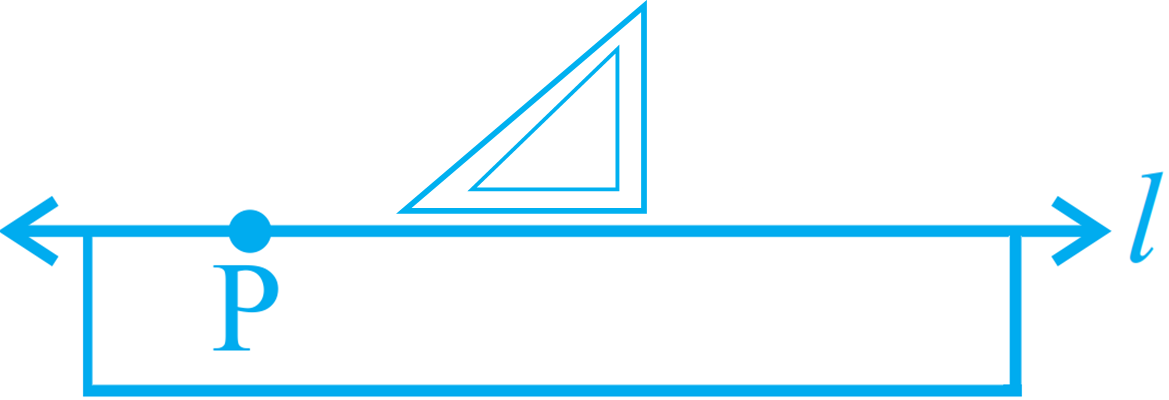
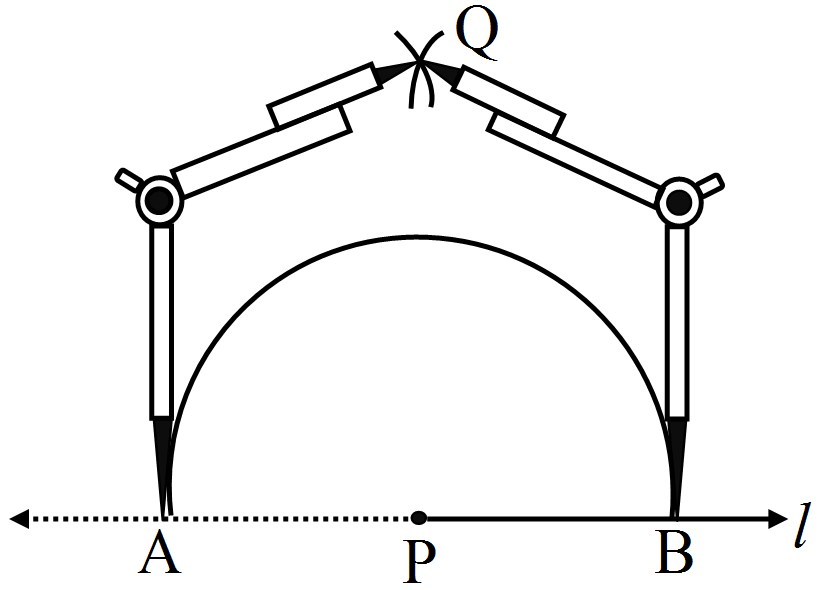
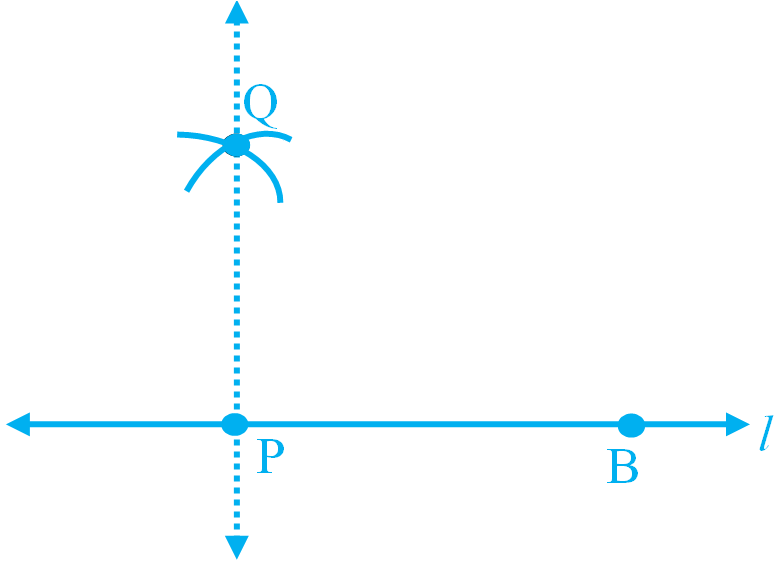
Copy Figure on your notebook and draw a perpendicular to l through $P,$ using $(i)$ set squares $(ii)$ Protractor $(iii)$ ruler and compasses. How many such perpendiculars are you able to draw?


Answer

 
We draw perpendicular to $l$ through $P$ using.
$i.\ $Set square:
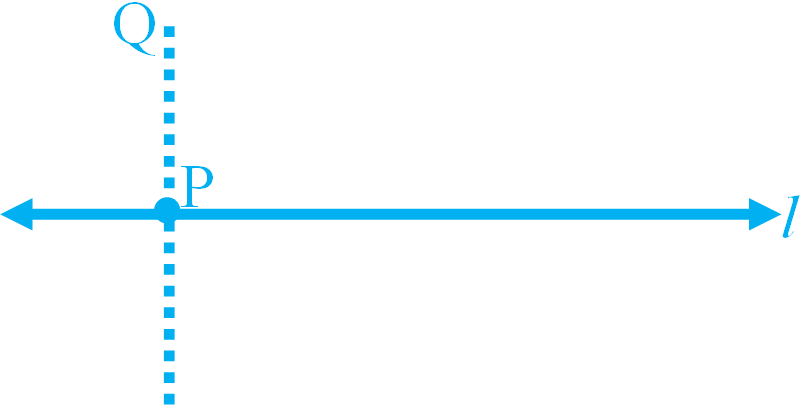
Steps of construction are as follows:
Step $I:$ A line $l$ and a point $P$ are given. Note that $P$ is on the line $l.$

Step $II:$ Place a ruler with one of its edges along $l$. Hold it firmly.

Step $III:$ Place a set square with one of its edges along the already aligned edge of the ruler, such that the right angled comer is in contact with the ruler.

Step $IV:$ Hold the set square firmly in this position. Draw $\overline{\text{PQ}}$ along the edge of the set square.

$ii.\ $Protractor:
Step $I:$ A line $l$ and a point $P$ are given. Note that $P$ is on the line $l.$​​​​​​​

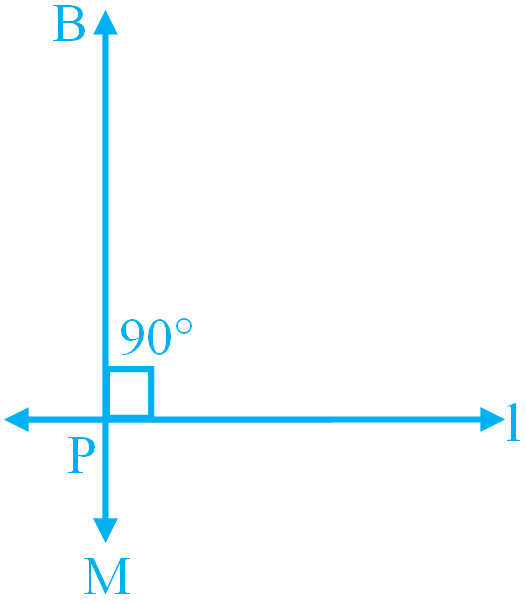
Step $II:$ Place the protractor on the line, such that its base line coincides with $ l$ and its centre falls on $P.$​​​​​​​
Step $III:$ Mark a point $B$ against the $90^\circ$ mark on the protractor.
Step $IV:$ Remove the protractor and draw a line m passing through $P$ and $B.$
Then, $\text{PB}\bot\text{l}$


$iii.\ $Ruler and Compass:
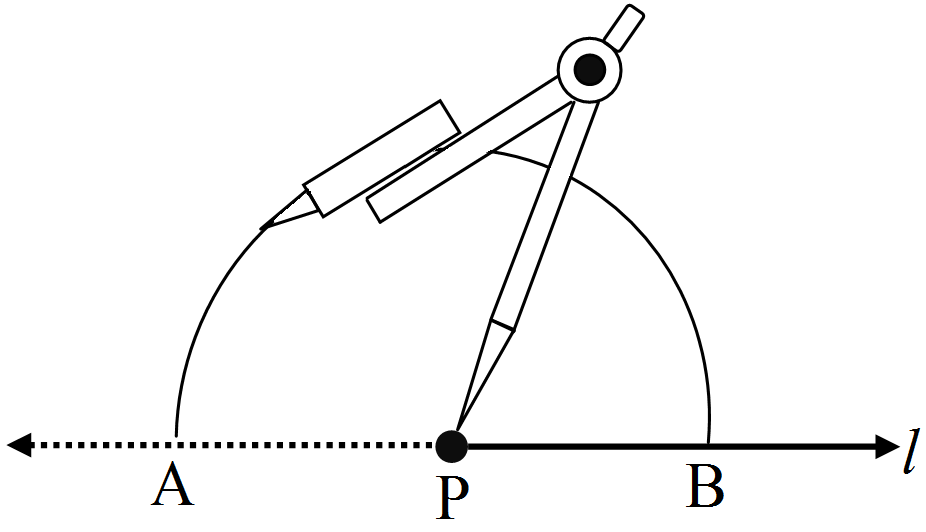
Step $I:$ Given, a point $P$ on a line $l.$​​​​​​​

Step $II:$ With $P$ as centre and a convenient radius, construct an arc intersecting the line $l$ at two points $A$ and $B.$​​​​​​​

Step III: With $A$ and $B$ as centres and a redius greater than $AP$ construct two arcs, which cut each other at $Q.$​​​​​​​

Step $IV:$ Join $PQ.$ Then, $PQ$ is perpendicular to $l.$​​​​​​​

Hence, we are able to draw one perpendicular line.
 

Need a full question paper?

Generate a complete, print-ready paper with questions like this in minutes — across 16+ boards, with answer keys.
Start Generating Free

Similar questions

There are $20$ girls and $15$ boys in a class. What is the ratio of number of girls to the total number of students in the class?
The weights of new born babies (in kg) in a hospital on a particular day are as follows:
2.3, 2.2, 2.1, 2.7, 2.6, 3.0, 2.5, 2.9, 2.8, 3.1, 2.5, 2.8, 2.7, 2.9,
(i) Rearrange the weights in descending order.
(ii) Determine the highest weight.
(iii) Determine the lowest weight.
(iv) Determine the range.
(v) How many babies were born on that day?
(vi) How many babies weigh below 2.5 kg?
(vii) How many babies weigh more than 2.8 kg?
(viii) How many babies weigh 2.8 kg?
Compare $\frac{4}{5}$ and $\frac{5}{6}$.
Draw an angle of $45^\circ $, using a pair of compasses.
Identify and name the line segments and rays in the following figure:
Draw an angle of $140^\circ$ with the help of a protractor and bisect it using ruler and compasses.
Given $\overline{\text{AB}}$ of length $7.3\ cm$ and $\overline{\text{CD}}$ of length $3.4\ cm,$ construct a line segment $\overline{\text{XY}}$ such that the length of $\overline{\text{XY}}$ is equal to the difference between the lengths of $\overline{\text{AB}}$ and $\overline{\text{CD}}$. Verify by measurement.
Give the correct matching of the statements of Column $A$ and Column $B.$
No.
Column A
 
Column B
$i$
Points are collinear.
$a.$
May be parallel or intersecting.
$ii$
Line is completely known.
 
$b.$
Are undefined terms in geometry.
$iii$
Two lines in a plane.
$c.$
If they lie on the same line.
$iv$
Relations between points and lines.
$d.$
Can pall through a point.
$v$
Three non-collinear points.
$e.$
Determine a plane.
$vi$
A plane extends.
$f.$
Are called incidence porperties.
$vii$
Indefinite number of lines.
$g.$
It two points are givne.
$viii$
Point, line and plane are.
$h.$
Indefinitely in all directions.
Solve the following equation and verify the answer: $\text{2x}-\frac{1}{2}=3$