MCQ
Correct acidic nature is
  • $HNO_3\, >\, H_3AsO_4\, >\, H_3PO_4$
  • B
    $HOF\, >\, HOBr\, >\, HOCl\, >\, HOI$
  • C
    $HClO_4\, >\, HBrO_4\, >\, HIO_4$
  • D
    $N_2O\, >\, NO\, >\, N_2O_3$

Answer

Correct option: A.
$HNO_3\, >\, H_3AsO_4\, >\, H_3PO_4$
a
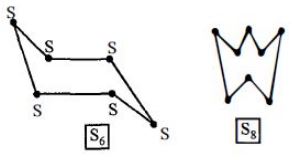
The $S_6$ molecule has a chair-form hexagon ring with the same bond length as that in $S_8$, but with some what smaller bond angles i.e. bond lengths are same but bond angles are different   

Need a full question paper?

Generate a complete, print-ready paper with questions like this in minutes — across 16+ boards, with answer keys.

Start Generating Free

Similar questions

The cell potential for $Zn \left| Zn ^{2+}( aq ) \| Sn ^{ x +}\right| Sn$ is $0.801$ $V$ at $298\,K$. The reaction quotient for the above reaction is $10^{-2}$. The number of electrons involved in the given electrochemical cell reaction is. .... (Given $E _{ Zn ^{2+} \mid Zn }^{0}=-0.763\,V , E _{ Sn ^{ x +} \mid Sn }^{0}=+0.008\,V$ and $\left.\frac{2.303\,RT }{ F }=0.06\,V \right)$
Specific reagent required for dehydrohalogenation is :
The difference in the reaction of phenol with bromine in chloroform and bromine in water medium is due to.
$STATEMENT-1$: Bromobenzene upon reaction with $\mathrm{Br}_2 / \mathrm{Fe}$ gives $1,4$ -dibromobenzene as the major product. and

$STATEMENT-2$: In bromobenzene, the inductive effect of the bromo group is more dominant than the mesomeric effect in directing the incoming electrophile.

Which is mild oxidising agent
Which of the following α-amino acids does not contain a chiral carbon?
The binding of oxygen by haemoglobin $(Hb)$ forming $(HbO_2)$, is partially regulated by the concentration of $H_3O^+$ and dissolved $CO_2$ in blood.

$Hb{O_2} + {H_3}{O^ + }C{O_2} \rightleftharpoons \left( {{H^ + } - Hb - C{O_2}} \right) + {O_2} + {H_2}O$

Release of $O_2$ is favoured when there is

The metal that shows highest and maximum number of oxidation state is:
Given below are two statement :

Statement $I$ : Bromination of phenol in solvent with low polarity such as $\mathrm{CHCl}_3$ or $\mathrm{CS}_2$ requires Lewis acid catalyst.

Statement $II$ : The lewis acid catalyst polarises the bromine to generate $\mathrm{Br}^{+}$.

In the light of the above statements, choose the correct answer from the options given below :

Which shows optical isomerism ?