MCQ
Correct order of electrophilic substitution reaction is :
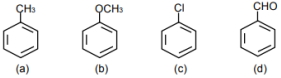
- A$a > b > c > d$
- B$d > b > a > c$
- C$b > a > c > d$
- ✓$b > a > d > c$
andelectron donating groups $(EDG)$ such as $- OR ,\,- R$ etc. attached to the aromatic ring.
$EWG$ groups decreases the electron density on ring and $EWG$
groups increases the electron density on ring.
Therefore, the correct order is :
$b > a > c > d$
Generate a complete, print-ready paper with questions like this in minutes — across 16+ boards, with answer keys.
| Observation | $[A]$ | $[B]$ | Rate of reaction |
| $1$ | $0.1$ | $0.1$ | $2\times10^{-3}\, mol\, L^{-1}\,sec^{-1}$ |
| $2$ | $0.2$ | $0.1$ | $0.4\times10^{-2}\, mol\, L^{-1}\,sec^{-1}$ |
| $3$ | $0.1$ | $0.2$ | $1.4\times10^{-2}\, mol\, L^{-1}\,sec^{-1}$ |
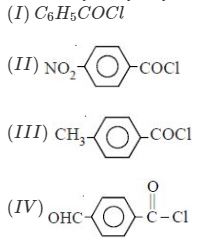
| Peptide | $R _1$ | $R _2$ |
| $I$ | $H$ | $H$ |
| $II$ | $H$ | $CH _3$ |
| $III$ | $CH _2 COOH$ | $H$ |
| $IV$ | $CH _2 CONH _2$ | $( CH _2)_4 NH _2$ |
| $V$ | $CH _2 CONH _2$ | $CH _2 CONH _2$ |
| $VI$ | $( CH _2)_4 NH _2$ | $( CH _2)_4 NH _2$ |
| $VII$ | $CH _2 COOH$ | $CH _2 CONH _2$ |
| $VIII$ | $CH _2 OH$ | $( CH _2)_4 NH _2$ |
| $IX$ | $( CH _2)_4 NH _2$ | $CH _3$ |

$\mathrm{BrO}_{4}^{-} \stackrel{1.82 \mathrm{V}}{\longrightarrow} \mathrm{BrO}_{3}^{-} \stackrel{1.5 \mathrm{V}}{\longrightarrow} \mathrm{HBrO}$$\stackrel{1.0652 \mathrm{V}}{\longrightarrow} \mathrm{Br}_{2} \stackrel{1.595 \mathrm{V}}{\longrightarrow} \mathrm{Br}^{-}$
Then the species undergoing disproportionation is