MCQ
Correct order of electrophilic substitution reaction is :
  • A
    $a > b > c > d$
  • B
    $d > b > a > c$
  • C
    $b > a > c > d$
  • $b > a > d > c$

Answer

Correct option: D.
$b > a > d > c$
d
The electrophilic substitution reaction depends upon electron withdrawing groups $(EWG)$ such as $- X,\,- CHO$ etc.

andelectron donating groups $(EDG)$ such as $- OR ,\,- R$ etc. attached to the aromatic ring.

$EWG$ groups decreases the electron density on ring and $EWG$

groups increases the electron density on ring.

Therefore, the correct order is :

$b > a > c > d$

Need a full question paper?

Generate a complete, print-ready paper with questions like this in minutes — across 16+ boards, with answer keys.

Start Generating Free

Similar questions

The observed magnetic moment of the complex $\left[ Mn (\underline{ NCS })_6\right]^{ x- }$ is $6.06\,BM$. The numerical value of $x$ is $.......$.
The metal $d-$ orbital that can directly facing the ligands in $K_3[Co(CN)_6]$ are
Assertion: $AgCl$ dissolves in $NH_4OH$ solution.

Reason: Due to formation of a complex

The reaction $C _2 H _5 ONa + C _2 H _5 I \rightarrow C _2 H _5 OC _2 H _5+ NaI$ is known as:
Given below are two statements:

Statement $(I)$: A solution of $\left[\mathrm{Ni}\left(\mathrm{H}_2 \mathrm{O}\right)_6\right]^{2+}$ is green in colour.

Statement $(II)$: A solution of $\left[\mathrm{Ni}(\mathrm{CN})_4\right]^{2-}$ is colourless.

In the light of the above statements, choose the most appropriate answer from the options given below:

In the following sequence of reactions,

$\mathrm{C}_{3} \mathrm{H}_{6} \stackrel{\mathrm{H}^{+} / \mathrm{H}_{2} \mathrm{O}}{\longrightarrow} A\xrightarrow[dil.\,KOH]{KIO} B+C$

The compounds $B$ and $C$ respectively are :
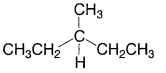
The maximum number of isomers (including stereoisomers) that are possible on monochlorination of the following compound, is
$C{H_3} - C{H_2} - CH = O\,\xrightarrow[{(2)\,\,{H^ \oplus }}]{{(1)\,\,{\text{Tollen's reagent}}}}X$ $\,\xrightarrow[{(2)\,\,{\text{drydistillation}}}]{{(1)\,Ca{{(OH)}_2}}}\,Y$ ; $Y$ is
$A$ and $B$ decompose via first order kinetics with half-lives $54.0\, min$ and $18.0\, min$ respectively. Starting from an equimolar non reactive mixture of $A$ and $B$, the time taken for the concentration of $A$ to become $16$ times that of $B$ is ...... $min.$ (Round off to the Nearest Integer).
$p- $Nitrobromobenzene can be converted to $p-$nitroaniline by using $NaN{H_2}$. The reaction proceeds through the intermediate named