MCQ
Correct order of $K_a$ value for given compound
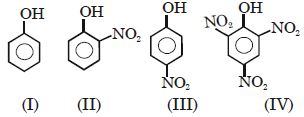
- A$IV > II > III > I$
- B$III > IV > II > I$
- ✓$IV > III > II > I$
- D$IV > III > I > II$
Generate a complete, print-ready paper with questions like this in minutes — across 16+ boards, with answer keys.
$Z{n^{2 + }}\,(aq)\, + \,2e\, \rightleftharpoons \,Zn\,(s)\,;\, - \,0.762\,V$
$C{r^{3 + }}\,(aq)\, + \,3e\, \rightleftharpoons \,Cr(s)\,;\, - \,0.740\,\,V$
$2{H^ + }\,(aq)\, + \,2e\, \rightleftharpoons \,{H_2}(g)\,;\,\,\,0.00\,\,\,V$
$F{e^{3 + }}\,(aq)\, + \,e\, \rightleftharpoons \,F{e^{2 + }}(aq)\,;\,\,\,0.770\,\,\,V$
Which is the strongest reducing agent ?
$\mathrm{BrO}_{4}^{-} \stackrel{1.82 \mathrm{V}}{\longrightarrow} \mathrm{BrO}_{3}^{-} \stackrel{1.5 \mathrm{V}}{\longrightarrow} \mathrm{HBrO}$$\stackrel{1.0652 \mathrm{V}}{\longrightarrow} \mathrm{Br}_{2} \stackrel{1.595 \mathrm{V}}{\longrightarrow} \mathrm{Br}^{-}$
Then the species undergoing disproportionation is
$C{r_2}O_7^{2 - } + F{e^{2 + }} + {C_2}O_4^{2 - } \to C{r^{3 + }} + F{e^{3 + }} + C{O_2}$ (Unbalanced)
| List$-I ($Molecule$)$ | List$-II($Shape$)$ | ||
| $A.$ | $NH_3$ | $I.$ | Square pyramid |
| $B.$ | $BrF_5$ | $II.$ | Tetrahedral |
| $C.$ | $PCl_5$ | $III$ | Trigonal pyramidal |
| $D.$ | $CH_4$ | $IV$ | Trigonal bipyramida |