MCQ
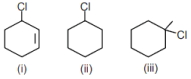
Correct order of $SN^1$ reaction is:
  • A
    $iii > i > ii$
  • B
    $iii > ii > i$
  • C
    $i > iii > ii$
  • $i > ii > iii$

Answer

Correct option: D.
$i > ii > iii$
d
The $S _{ N } 1$ reaction is a single step reaction and given by less bulky groups.

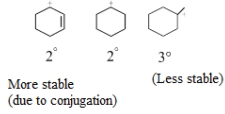
The ease of carbocation towards $S_{N} 1$ reaction is shown below. $3^{\circ}<2^{\circ}<1^{\circ}$.

So, the correct order is $i > ii >$ $iii$

Therefore, option $(D)$ is the correct.
Need a full question paper?

Generate a complete, print-ready paper with questions like this in minutes — across 16+ boards, with answer keys.

Start Generating Free

Similar questions

The structure of external most shell of inert gases is
In $KI$ solution, ${I_2}$ readily dissolves and forms
For the reaction, ${A_{(s)}} + 3{B_{(g)}} \to 4{C_{(s)}} + {D_{(l)}}$. $\Delta H$ and $\Delta U$ are related as ………
On heating a mixture of $SO_2Cl_2$ and $CO$ two equilibria are simultaneously established

$S{O_2}C{l_2}\left( g \right) \rightleftharpoons S{O_2}\left( g \right) + C{l_2}\left( g \right)$

$CO\left( g \right) + C{l_2}\left( g \right) \rightleftharpoons COC{l_2}\left( g \right)$

on adding more $SO_2$ at equilibrium what will happen?

Given below are two statements:

Statement $(I)$ : The $\mathrm{NH}_2$ group in Aniline is ortho and para directing and a powerful activating group.

Statement $(II)$ : Aniline does not undergo FriedelCraft's reaction (alkylation and acylation).

In the light of the above statements, choose the most appropriate answer from the options given below :

The $d-$ electron configurations of $cr^{2+}, Mn^{2+}, Fe^{2+}$ and $Co^{2+}$ are $d^4, d^5, d^6$ and $d^7$ respectively. Which one of the following will exhibit the lowest paramagnetic behaviour? (Atomic no.$Cr = 24,\,Mn = 25,\,Fe = 26,\,Co = 27$).
In the reaction

$xBrO_3\,^-+ yCr^{+3} + zH_2O \to Br_2 + CrO_4 ^{-2} + H^+$

the coefficients $x, y, z$ are

Which of the following statements about galvanic cell is incorrect
Osmotic pressure of a urea solution at ${10\,^o}C$ is $500\,\,mm.$ Osmotic pressure of the solution become $105.3 \,mm$. When it is diluted and temperature raised to ${25\,^o}C.$ The extent of dilution is .......... times
Le-Chatelier principle is not applicable to