MCQ
Correct relation of Heisenberg uncertainity principle is:
  • $\Delta v \cdot \Delta x=\frac{h}{4 \pi m}$
  • B
    $\Delta v \cdot \Delta x=\frac{4 \pi m}{h}$
  • C
    $\Delta v \cdot \Delta h =\frac{ x }{4 \pi m}$
  • D
    $\Delta h \cdot \Delta x =\frac{ v }{4 \pi m}$

Answer

Correct option: A.
$\Delta v \cdot \Delta x=\frac{h}{4 \pi m}$
(A)
$\Delta v \cdot \Delta x=\frac{h}{4 \pi m}$

Need a full question paper?

Generate a complete, print-ready paper with questions like this in minutes — across 16+ boards, with answer keys.

Start Generating Free

Similar questions

Which of the following structures represents the lowest-energy form of $(1S, 2S,
4R)$ -trimethyl -cyclohexane?
Concentration of the $Ag^+$ ions in a saturated solution of $Ag_2C_2O_4$ is $2.2 \times 10^{-4}\, mol\, L^{-1} .$ Solubility product of $Ag_2C_2O_4$ is
Chemical reactions involve interaction of atoms and molecules. A large number of atoms/molecules (approximately $6.023 \times 10^{23}$ ) are present in a few grams of any chemical compound varying with their atomic/molecular masses. To handle such large numbers conveniently, the mole concept was introduced. This concept has implications in diverse areas such as analytical chemistry, biochemistry, electrochemistry and radiochemistry. The following example illustrates a typical case, involving chemical/electrochemical reaction, which requires a clear understanding of the mole concept.

A $4.0$ molar aqueous solution of $\mathrm{NaCl}$ is prepared and $500 \mathrm{~mL}$ of this solution is electrolysed. This leads to the evolution of chlorine gas at one of the electrodes (atomic mass: $\mathrm{Na}=23, \mathrm{Hg}=200 ; 1$ Faraday $=96500$ coulombs)

$1.$ The total number of moles of chlorine gas evolved is

$(A)$ $0.5$  $(B)$ $1.0$  $(C)$ $2.0$  $(D)$ $3.0$

$2.$  If the cathode is a $\mathrm{Hg}$ electrode, the maximum weight ( $\mathrm{g}$ ) of amalgam formed from this solution is

$(A)$ $200$  $(B)$ $225$  $(C)$ $400$  $(D)$ $446$

$3.$ The total charge (coulombs) required for complete electrolysis is

$(A)$ $24125$  $(B)$ $48250$  $(C)$ $96500$  $(D)$ $193000$

Give the answer question $1,2$ and $3.$
The $IUPAC$ name of the compound $Br(Cl) CI\cdot CF_3$ is :
Consider the van der Waals constants, $a$ and $b$, for the following gages,

gas $Ar$ $Ne$ $Kr$ $Xe$
$a /\left( atm \,dm ^{6} \,mol ^{-2}\right)$ $1.3$ $0.2$ $5.1$ $4.1$
$b /\left(10^{-2} \,dm ^{3}\, mol ^{-1}\right)$ $3.2$ $1.7$ $1.0$ $5.0$

Which gas is expected to have the highest critical temperature? 

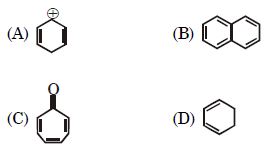
Which of the following are aromatic species?
$KMn{O_4}$ in basic medium is reduced to
The heat of combustion of carbon is $-94\,  kcal$ at $ 1$ atm pressure. The intrinsic energy of $C{O_2}$ is....$kcal$
For a first order reaction $A \rightarrow$ Products, initial concentration of $A$ is $0.1\, M$, which becomes $0.001 \,M$ after $5$ minutes. Rate constant for the reaction in $\min ^{-1}$ is .... .
Heat of neutralisation of weak acid and strong base is less than the heat of neutralisation of strong acid and strong base due to