MCQ
Correct stability order of the given tautomers is
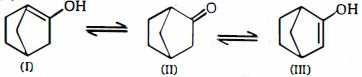
- A$I > II > III$
- B$III > II > I$
- C$II > I > III$
- ✓$II > III > I$
Generate a complete, print-ready paper with questions like this in minutes — across 16+ boards, with answer keys.
|
List-$I$ Reaction |
List-$II$ Type of redox reaction |
| $(A)$ $\mathrm{N}_{2(\mathrm{~g})}+\mathrm{O}_{2(\mathrm{~g})} \rightarrow 2 \mathrm{NO}_{(\mathrm{g})}$ | $(I)$ Decomposition |
| $(B)$ $\begin{aligned} & 2 \mathrm{~Pb}\left(\mathrm{NO}_3\right)_{2(\mathrm{~s})} \rightarrow 2 \mathrm{PbO}_{(\mathrm{s})}+4 \mathrm{NO}_{2(\mathrm{~g})}+\mathrm{O}_{2(\mathrm{~g})}\end{aligned}$ | $(II)$ Displacement |
| $(C)$ $\begin{aligned} 2 \mathrm{Na}_{(\mathrm{s})}+2 \mathrm{H}_2 \mathrm{O}_{(\mathrm{l})} \rightarrow 2 \mathrm{NaOH}_{(\mathrm{aq} .)}+\mathrm{H}_{2(\mathrm{~g})}\end{aligned}$ | $(III)$ Disproportionation |
| $(D)$ $\begin{aligned} 2 \mathrm{NO}_{2(\mathrm{~g})}+2-\mathrm{OH}_{(\mathrm{aq})} \rightarrow \mathrm{NO}_{2(\mathrm{aq} .)}^{-}+\mathrm{NO}_{3(\mathrm{qq} .)}^{-}+\mathrm{H}_2 \mathrm{O}_{(\mathrm{l})}\end{aligned}$ | $(IV)$ Combination |
Choose the correct answer from the options given below:
$Cu^{2+}_{(aq)} + e^- \rightarrow Cu^+_{(aq)}$ and $Cu^+_{(aq)} + e^- \rightarrow Cu_{(s)}$ are $+ 0.15\, V$ and $+ 0.50\, V$ respectively. The value of $E^o_{Cu^{2+}/Cu}$ will be ........ $V$
$Image$