MCQ
Correct statement regarding above sequence of reaction.
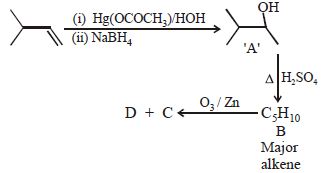
  • A
    A give immediate turbidity with Lucas reagent
  • B
    Total possible isomer of $B$ is $10$
  • C
    Product $C$ & $D$ both give $-ve$ Iodoform test
  • Product $C$ & $D$ both form crystal with $NaHSO_3$ ($+ve\ NaHSO_3$ test)

Answer

Correct option: D.
Product $C$ & $D$ both form crystal with $NaHSO_3$ ($+ve\ NaHSO_3$ test)
d

Need a full question paper?

Generate a complete, print-ready paper with questions like this in minutes — across 16+ boards, with answer keys.

Start Generating Free

Similar questions

For a $A g-Z n$ button cell, net reaction is $Z n(s)+A g_{2} O(s) \operatorname{Zn} O(s)+2 A g(s)$

$\Delta G_{f}^{o}\left(A g_{2} O\right)=-11.21\, kJ\,mol ^{-1}$

$\Delta G_{f}^{o}(Z n O)=-318.3\, kJ \,mol ^{-1}$

Then, $E^{o}$ cell of the button cell is.........$V$

In $C{l_2}{O_6}\left( l \right) + HF \to P + Q$ If $H $ of acid $HF$ attaches with $Q$, then correct option for hybridization of $Cl-$ atom and $\angle OClO$ in the $P$ and $Q$ ions
$A ( g ) \rightarrow 2 B ( g )+ C ( g )$ is a first order reaction. The initial pressure of the system was found to be $800\,mm\,Hg$ which increased to $1600\,mm\,Hg$ after $10\,min$. The total pressure of the system after $30\,min$ will be $.........\,mm\,Hg$. (Nearest integer)
The Hinsberg reagent is.
The binding of oxygen by haemoglobin $(Hb)$ forming $(HbO_2)$, is partially regulated by the concentration of $H_3O^+$ and dissolved $CO_2$ in blood.

$Hb{O_2} + {H_3}{O^ + }C{O_2} \rightleftharpoons \left( {{H^ + } - Hb - C{O_2}} \right) + {O_2} + {H_2}O$

Release of $O_2$ is favoured when there is

Glycerol $\xrightarrow{{KHS{O_4}}}A\xrightarrow{{LiAl{H_4}}}B$

$A$ and $B$ are :

Which of the following is the example of $S{N^2}$ reaction
$2-$ bromopentane is heated with potassium ethoxide in ethanol. The major product obtained is
For a reaction $\frac{1}{2} A \rightarrow 2B,$ rate of disappearance of $'A'$ is related to the rate of appearance of $'B'$ by the expression
The colloidal dispersion of a liquid in a liquid is called: