MCQ
Coulomb's law is a confirmation of______
- Ainverse cube law
- Bproduct law
- Cinverse square law
- DNone of the above
Explanation:
According to Coulomb's Law-
$\text{F}\propto\frac{1}{\text{r}^2}$
Hence, Coulomb's Law is a confirmation of inverse square law.
Generate a complete, print-ready paper with questions like this in minutes — across 16+ boards, with answer keys.
A uniform electric field having a magnitude  and direction along the positive X - axis exists. If the potential V is zero at x = 0, then its value at X = +x will be
|
(a) |
(b) |
(c) |
(d) |
Light of wavelength 5000 Å falls on a sensitive plate with photoelectric work function of 1.9 eV. The kinetic energy of the photoelectron emitted will be
|
(a) 0.58 eV |
(b) 2.48 eV |
(c) 1.24 eV |
(d) 1.16 eV |
Assertion : The comet do not obey Kepler's laws of planetary motion
Reason : The comet do not have elliptical orbit
|
(a) If both assertion and reason are true and the reason is the correct explanation of the assertion. |
|
(b) If both assertion and reason are true but reason is not the correct explanation of the assertion. |
|
(c) If assertion is true but reason is false. |
|
(d) If the assertion and reason both are false. |
In the lowest energy level of hydrogen atom, the electron has the angular momentum
|
(a) |
(b) h/ |
(c) h/2 |
(d) |
Which of the following is most unstable
|
(a) Electrons |
(b) Protons |
(c) Neutrons |
(d) α -particle |
Assertion : Lenz’s law violates the principle of conservation of energy.
Reason : Induced e.m.f., opposes always the change in magnetic flux responsible for its production.
|
(a) If both assertion and reason are true and the reason is the correct explanation of the assertion. |
|
(b) If both assertion and reason are true but reason is not the correct explanation of the assertion. |
|
(c) If assertion is true but reason is false. |
|
(d) If assertion is false but reason is true. |
An alternating voltage of 141.4V (rms) is applied to a vacuum diode as shown in the figure. The maximum potential difference across the condenser will be
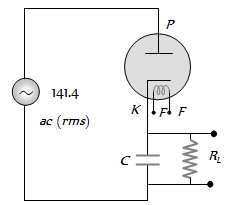
|
(a) 100 V |
(b) 200 V |
(c) 100 |
(d) 200 |
A man can see only between 75 cm and 200 cm. The power of lens to correct the near point will be
|
(a) + 8/3 D |
(b) + 3 D |
(c) – 3 D |
(d) – 8/3 D |
The resistivity of a potentiometer wire is 40  and its area of cross-section is 8
  . If 0.2 amp current is flowing through the wire, the potential gradient will be
|
(a) |
(b) |
(c) 3.2 |
(d) 1 volt/m |


