MCQ
$Cu(CN)_4^{2 - }$ is colourless as it absorbs light in
- AVisible region
- BUltraviolet region
- CInfrared region
- ✓All above are wrong
Generate a complete, print-ready paper with questions like this in minutes — across 16+ boards, with answer keys.
$(A)$ $\Lambda \stackrel{0}{ m }$ for electrolyte $A$ is obtained by extrapolation
$(B)$ For electrolyte B, vx $\Lambda m$ vs $\sqrt{ c }$ graph is a straight line with intercept equal to $\Lambda \stackrel{0}{ m }$
$(C)$ At infinite dilution, the value of degree of dissociation approach zero for electrolyte $B$.
$(D)$ $\Lambda \stackrel{0}{ m }$ for any electrolyte $A$ or $B$ can be calculated using $\lambda^{\circ}$ for individual ions.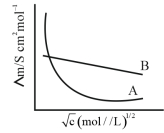
$(A)$ A secondary alcohol on oxidation gives a ketone
$(B)$ Ethanol reacts with conc. ${H_2}S{O_4}$ at ${180\,^o}C$ to yield ethylene
$(C)$ Methanol reacts with iodine and sodium hydroxide to give a yellow precipitate of iodoform
$(D)$ Hydrogen gas is liberated when sodium is added to alcohol. Select the correct statements from the above set:
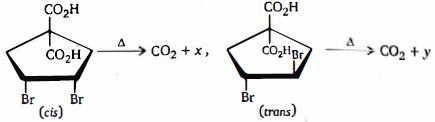
The number of poss ible products for $x$ and $y$ are