MCQ
$[Cu(CN)_4]^{2-}$ is more stable than $[Cu(NH_3)_4]^{2+}$ because :-
  • A
    stability constant of $[Cu(CN)_4]^{2-}$ is greater than $[Cu(NH_3)_4]^{2+}$
  • B
    $CN^-$ is stronger ligand than $NH_3$
  • both $(A)\, \& \,(B)$
  • D
    none

Answer

Correct option: C.
both $(A)\, \& \,(B)$
c

Need a full question paper?

Generate a complete, print-ready paper with questions like this in minutes — across 16+ boards, with answer keys.

Start Generating Free

Similar questions

Partial pressure of a solution component is directly proportional to its mole fraction. This is known as:
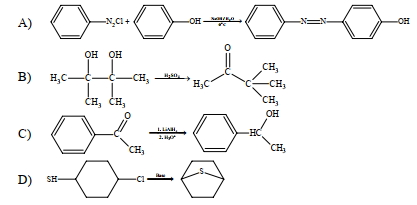
Match the reactions in Column $I$ with appropriate options in Column $II$.
Column $I$ Column $II$
$(A)$ $Image$ $(p)$ Racemic mixture
$(B)$ $Image$ $(q)$ Addition reaction
$(C)$ $Image$ $(r)$ Substitution reaction
$(D)$ $Image$ $(s)$ Coupling reaction
  $(t)$ Carbocation intermediate

Among Valine, Leucine, Isoleucine, Lysine and Phenyl alanine, odd member is:
Which of the following is a cyclic phosphate
A black sulphide ppt when treated with ozone becomes white, the white compound is
The variation of the rate of an enzyme catalyzed reaction with substrate concentration is correctly represented by graph
Which statement is not true
Which of the following isomerism does not found in ethers :
$(i)\,\,\begin{matrix}
   CHO\,\,\,\,\,\,\,\,\,\,\,\,\,\,\,\,\,\,\,\,\,  \\
   |\,\,\,\,\,\,\,\,\,\,\,\,\,\,\,\,\,\,\,\,\,\,\,\,\,\,\,\,\,\,\,  \\
   {{(CH-OH)}_{3}}\,\,\,\,\,\,  \\
   |\,\,\,\,\,\,\,\,\,\,\,\,\,\,\,\,\,\,\,\,\,\,\,\,\,\,\,\,\,\,\,  \\
   \,\,C{{H}_{2}}-OH\,\,\,\,\,\,\,\,\,\,  \\
\end{matrix}\xrightarrow{4HI{{O}_{4}}} Product$ $(ii)\,\,\begin{matrix}
   C{{H}_{2}}OH\,\,\,\,\,\,\,\,\,\,\,\,\,\,\,\,  \\
   |\,\,\,\,\,\,\,\,\,\,\,\,\,\,\,\,\,\,\,\,\,\,\,\,\,\,\,\,\,\,\,  \\
   {{(CH-OH)}_{4}}\,\,\,\,\,\,  \\
   |\,\,\,\,\,\,\,\,\,\,\,\,\,\,\,\,\,\,\,\,\,\,\,\,\,\,\,\,\,\,\,  \\
   \,\,C{{H}_{2}}-OH\,\,\,\,\,\,\,\,\,\,  \\
\end{matrix}\xrightarrow{5HI{{O}_{4}}} Product$

Ratio of moles of formic acid obtained in reaction $(i)$ and reaction $(ii)$ is

How many structural isomers are possible for a compound with molecular formula ${C_3}{H_7}Cl$