MCQ
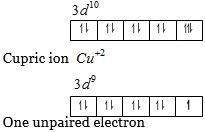
Cuprous ion is colourless, while cupric ion is coloured because
  • A
    Both have unpaired electrons in $d$-orbital
  • Cuprous ion has a completed $d$-orbital and cupric ion has an incomplete $d$-orbital
  • C
    Both have half-filled $p$and $d$-orbitals
  • D
    Cuprous ion has incomplete $d$-orbital and cupric ion has a completed $d$-orbital
Answer

Correct option: B.
Cuprous ion has a completed $d$-orbital and cupric ion has an incomplete $d$-orbital
b
(b)Cuprous ion $(C{u^ + })$ $3{d^{10}}$ Completely filled $d $ sub shell

Need a full question paper?

Generate a complete, print-ready paper with questions like this in minutes — across 16+ boards, with answer keys.

Start Generating Free

Similar questions

An organic compound on analysis gave $C = 48\, gm$, $H = 8 \,gm$ and $N = 56\, gm$. Volume of $1.0\, g$ of the compound was found to be $200 \,ml$ at $NTP$. Molecular formula of the compound is
Vapour pressure of a pure solvent at $90\,^oC$ is $1020\, torr$. A solution of $0.1\, m$ concentration has a vapour pressure of $1000\, torr$. What is the molecular weight of solvent ?
Which part of the protein molecule is responsible for function and activity of the proteins
For the formation of covalent bond, the difference in the value of electronegativities should be
Dilute nitric acid on reaction with $Ag$ liberates
A certain compound has the molecular formula $X_4O_6$. If $10\,g$ of $X_4O_6$ has $5.72\,g$ of $X$. Atomic mass of $X$ is ............ $\mathrm{amu}$
The number of electrons which can be accommodated in an orbital is
Given below are two statements :
Statement $I :$ Picric acid is $2, 4, 6-$trinitrotoluene.
Statement $II :$ Phenol$-2, 4-$disulphuric acid is treated with conc. $HNO_3$ to get picric acid. In the light of the above statement, choose the most appropriate answer from the options given below :
$(1) $ Statement $I$ is incorrect but Statement $II$ is correct.
$(2)$ Both Statement $I$ and Statement $II$ are incorrect.
$(3)$ Statement $I$ is correct but Statement $II$ is incorrect.
$(4)$ Both Statement $I$ and Statement $II$ are correct.
An organic compound $‘X’$ showing the following solubility profile is

$'X'\,\,\xrightarrow{{water}}$  Insoluble

$'X'\xrightarrow{{5\% \,HCl}}$  Insoluble

$'X'\xrightarrow{{10\% \,NaOH}}$  Insoluble

$'X'\xrightarrow{{10\% \,NaHC{O_3}}}$  Insoluble

$0.05 \mathrm{M} \mathrm{CuSO}_4$ when treated with $0.01 \mathrm{M} \mathrm{K}_2 \mathrm{Cr}_2 \mathrm{O}_7$ gives green colour solution of $\mathrm{Cu}_2 \mathrm{Cr}_2 \mathrm{O}_7$. The [$SPM$ : Semi Permeable Membrane]

${K}_2 \mathrm{Cr}_2 \mathrm{O}_7$  &  ${CuSO}_4$

SideX $SPM$ Side $\mathrm{Y}$ Due to osmosis :