MCQ
Cuprous ion is colourless while cupric ion is coloured because
  • A
    Both have half filled $p $ and $d-$ orbitals
  • B
    Cuprous ion has incomplete $d-$ orbital and cupric ion has a complete $d-$ orbital
  • C
    Both have unpaired electrons in the $d-$ orbitals
  • Cuprous ion has a complete $ d-$ orbital and cupric ion has an incomplete $ d-$ orbital
Answer

Correct option: D.
Cuprous ion has a complete $ d-$ orbital and cupric ion has an incomplete $ d-$ orbital
d
It’s Obvious.
 

Need a full question paper?

Generate a complete, print-ready paper with questions like this in minutes — across 16+ boards, with answer keys.

Start Generating Free

Similar questions

A $4$ ampere is passed through a solution of zinc sulphate for $50\, minutes$. Find the amount of zinc deposited at the cathode ............. $\mathrm{g}$
Strong reducing behaviour of $\mathrm{H}_3 \mathrm{PO}_2$ is due to
Potassium permagnate works as oxidising agent both in acidic and basic medium. In both state product obtained by $KMn{O_4}$ is respestively
Gradual addition of electronic shells in the noble gases causes a decrease in their
For a reaction whose rate expression is : Rate $ = k{[A]^{1/2}}{[B]^{3/2}}$, the order would be
The van't Hoff factor $'i'$ for a compound which undergoes dissociation in one solvent and association in other solvent is respectively
$\mathop {Xe\,\, + \,\,{F_2}}\limits_{(1:20)} \,\xrightarrow{{573\,\,K,60.70\,\,bar}}A$

What is $A$

Reaction of    $R-C -NH_2$ with a mixture of $Br_2$ and $KOH$ gives 
                              $||$
                              $O$
 $R -NH_2$ asthe  main product. The intermediates involved in this reaction are :-

$(A)$ $\begin{matrix}
   O\,\,\,\,\,\,\,\,\,\,  \\
   ||\,\,\,\,\,\,\,\,\,\,\,\,  \\
   R-C-NHBr  \\
\end{matrix}$               $(B)$ $R-NH-Br$

$(C)$ $R-N=C=O$                $(D)$ $\begin{matrix}
   \,\,\,\,O\,\,\,\,\,\,\,\,\,\,  \\
   \,\,\,\,\,\,||\,\,\,\,\,\,\,\,\,\,\,\,  \\
   R-C-NB{{r}_{2}}  \\
\end{matrix}$

The $ppm$ level of $F^-$ in a $500\, g$ sample of a tooth paste containing $0.2\, g$ $F^-$ is
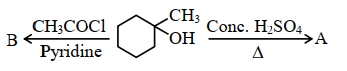
Identify the major products $A$ and $B$ respectively in the following set of reactions.