MCQ
Current carrier in conductors is $........$?
  • Electron
  • B
    Proton
  • C
    Neutron
  • D
    Positron

Answer

Correct option: A.
Electron

Conductors have lots of free electrons that can carry electricity if the potential difference is applied across them. Protons are positively charged particle and Neutron are electrically neutral. They don’t carry electricity in conductors.

Need a full question paper?

Generate a complete, print-ready paper with questions like this in minutes — across 16+ boards, with answer keys.

Start Generating Free

Similar questions

When yellow light is incident on a surface, no electrons are emitted while green light can emit. If red light is incident on the surface, then
Statement $-1$ : A nucleus having energy $E _{1}$ decays $\beta^{-}$ emission to daughter nucleus having energy $E _{2}$ but the $\beta^{-}$rays are emitted with a continuous energy spectrum having end point energy $E _{1}- E _{2}$

Statement $-2$ : To conserve energy and momentum in $\beta$ decay at least three particles must take part in the transformation.
The addition of antimony atoms to a sample of intrinsic germanium transforms it to a material which is
An electron accelerated through a potential difference $V_1$ has a de-Broglie wavelength of $\lambda$. When the potential is changed to $V _2$, its de-Broglie wavelength increases by $50 \%$. The value of $\left(\frac{ V _1}{ V _2}\right)$ is equal to :
In Young's double slit experiment, if the slit widths are in the ratio $1 : 9$, then the ratio of the intensity at minima to that at maxima will be
In an electrical circuit, which of the following quantities is analogous to temperature?
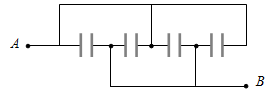
Four condensers are joined as shown in the adjoining figure. The capacity of each is 8 μF. The equivalent capacity between the points A and B will be
The wrong statement about electric lines of force is
In potentiometer a balance point is obtained, when:
The distance between object and the screen is $100\,cm$. A lens produces an image on the screen when it is placed at either of position $40\,cm$ apart.Then the power of the lens is (approximately)