Question
Current is allowed to flow in a metallic wire at a constant potential difference. When the wire becomes hot, cold water is poured on half of its portion. By doing so, its other half portion becomes still more hot. Explain its reason.

Answer

When cold water is poured on half the wire, the resistance of this portion decreases, and hence the current $\text{I}=\frac{\text{V}}{\text{R}}$ in whole wire increases and so the other half portion becomes still more hot.

Need a full question paper?

Generate a complete, print-ready paper with questions like this in minutes — across 16+ boards, with answer keys.
Start Generating Free

Similar questions

The photoelectric cut-off voltage in a certain experiment is 1.5 V. What is the maximum kinetic energy of photoelectron emitted?
Write short note on Nuclear Force.
Find the maximum kinetic energy of the photoelectrons ejected when light of wavelength 350nm is incident on a cesium surface. Work function of cesium = 1.9eV
Answer the following questions:
  1. Draw a graph showing variation of photocurrent with anode potential for a particular intensity of incident radiation. Mark saturation current and stopping potential.
  2. By how much would be stopping potential for a given photosensitive surface go up if the frequency of the incident radiations were to be increased from $4 \times 10^{15}\ Hz$ to $8 \times 10^{15}\ Hz$?
It is proposed to move a particle in simple harmonic motion on a rough horizontal surface by applying an external force along the line of motion. Sketch the graph of the applied force against the position of the particle. Note that the applied force has two values for a given position depending on whether the particle is moving in positive or negative direction.
An athelete takes 2.0s to reach his maximum speed of 18.0km/h. What is the magnitude of his average acceleration?
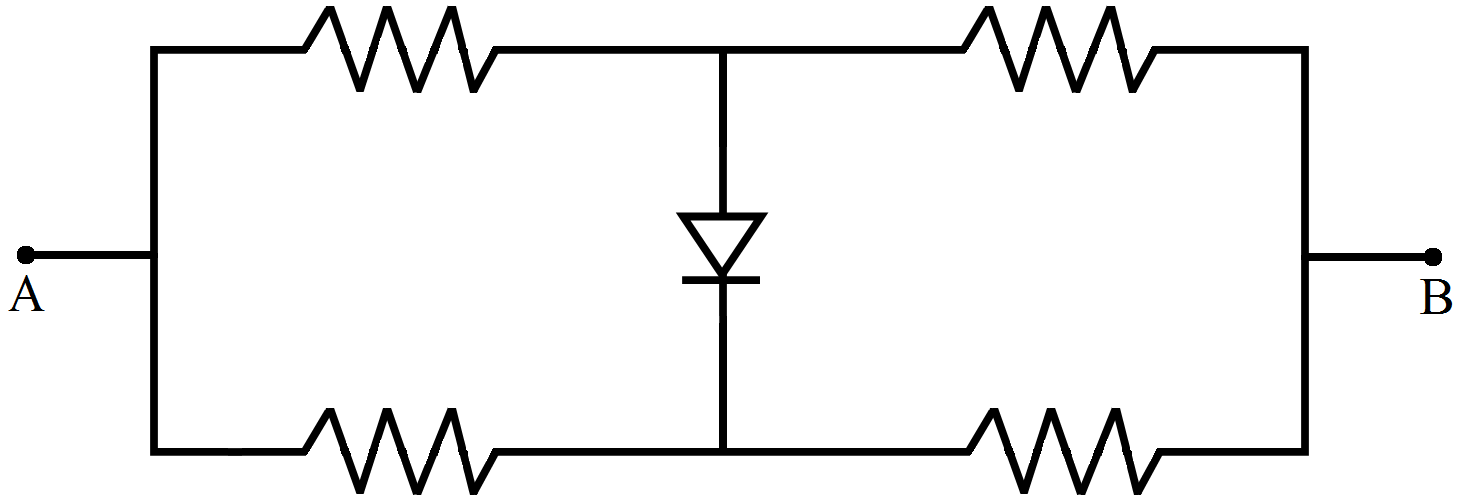
Each of the resistances shown in figure. has a value of $20\Omega.$ Find the equivalent resistance between A and B. Does it depend on whether the point A or B is at higher potential?
An optical fibre $(\mu=1.72)$ is surrounded by a glass coating $(\mu=1.50).$ Find the critical angle for total internal/ reflection at the fibre-glass interface.
Find the ratio of the mean speed of hydrogen molecules to the mean speed of nitrogen molecules in a sample contammg a mixture of the two gases.
An electron is not deflected while passing through any field. Is it possible that there is no magnetic field present at that place? Explain.