Question
Current is allowed to flow in a metallic wire at a constant potential difference. When the wire becomes hot, cold water is poured on half of its portion. By doing so, its other half portion becomes still more hot. Explain its reason.

Answer

When cold water is poured on half the wire, the resistance of this portion decreases, and hence the current $\text{I}=\frac{\text{V}}{\text{R}}$ in whole wire increases and so the other half portion becomes still more hot.

Need a full question paper?

Generate a complete, print-ready paper with questions like this in minutes — across 16+ boards, with answer keys.
Start Generating Free

Similar questions

Describe briefly with the help of a circuit diagram, how the flow of current carriers in a p-n-p transistor is regulated with emitter-base junction forward biased and base-collector junction reverse biased.
The refractive index of a material of a concave lens is $n_1$. It is immersed in a medium of refractive index $n_2 A$ parallel beam of light is incident on the lens. Trace the path of emergent rays when (i) $n_2=n_1$ (ii) $n_2>n_1$ (iii) $n_2<n_1$.
$\frac{1}{\text{f}}=\Big(\frac{\text{n}_1}{\text{n}_2}-1\Big)\Big(\frac{1}{\text{R}_2}-\frac{1}{\text{R}_2}\Big)$
The radius of a spherical conductor shell is $R$ and the charge on it is $Q$. Compare the potential at a distance 2 R from the centre of the sphere with the potential at a distance $R / 2$.
Calculate the mass of an $\alpha$-particle. Its binding energy is 28.2MeV.
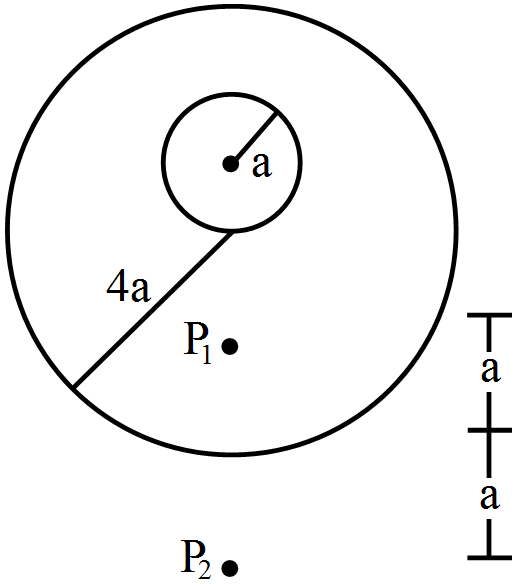
A uniform metal sphere of radius a and mass M is surrounded by a thin uniform spherical shell of equal mass and radius 4a The centre of the shell falls on the surface of the inner sphere. Find the gravitational field at the points $P_1$ and $P_2$ shown in the figure.
In measuring time period of a pendulum, it is advised to measure the time between consecutive passage through the mean position in the same direction. This is said to result in better accuracy than measuring time between consecutive passage through an extreme position. Explain.
The charge on a proton is $+1.6 \times 10^{-19} \mathrm{C}$ and that on an electron is $-1.6 \times 10^{-19} \mathrm{C}$. Does it mean that the electron has a charge 3.2 $\times 10^{-19} \mathrm{C}$ less than the charge of a proton?
Explain the difference between non-polar and polar atoms or molecules by giving examples.
A 10m wide spacecraft moves through the interstellar space at a speed $3 \times 10^7m/s^{-1}.$ A magnetic field $B = 3 \times 10^{-10}T$ exists in the space in a direction perpendicular to the plane of motion. Treating the spacecraft as a conductor, calculate the emf induced across its width.
Explaination of experimental results of photoelectric effect with Einstein's equation.