Question
Current is flowing in two parallel good conducting wires in the same direction. They will
Answer

(c )not exert any force

Need a full question paper?

Generate a complete, print-ready paper with questions like this in minutes — across 16+ boards, with answer keys.

Start Generating Free

Similar questions

Two cells of emfs approximately 5V and 10V are to be accurately compared using a potentiometer of length 400cm.
The dielectric strength of a medium is $2 kV mm ^{-1}$ What is the maximum potential difference that can be established across a $50 \mu m$ sample without binding?
An object is placed 40 cm  from a concave mirror of focal length 20 cm  The image formed is(a) Real, inverted and same in size(b) Real, inverted and smaller(c) Virtual, erect and larger(d) Virtual, erect and smaller
   
   
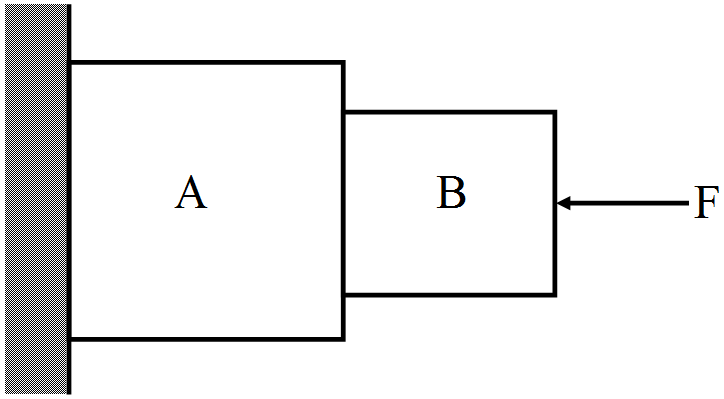
Consider the situation shown in figure. The wall smooth but the surface of A and B in contact are rough. The friction on B due to A in equilibrium:
  1. Is upward.
  2. Is downward.
  3. Is zero.
  4. The system cannot remain in equilibrium.
In Fresnel diffraction, if the distance between the disc and the screen is decreased, the intensity of central bright spot will(a) Increase(b) Decrease(c) Remain constant(d) None of these
       
A proton exerts a force on a proton which is:
  1. Gravitational.
  2. Electromagnetic.
  3. Nuclear.
  4. Weak.
A metal sheet is placed in front of a strong magnetic pole. A force needed to:
  1. Hold the sheet there if the metal is magnetic.
  2. Hold the sheed there if the metal is nonmagnetic.
  3. Move the sheet away from the pole with uniform velocity if the metal is magnetic.
  4. Move the sheet away from the pole with uniform velocity if the metal is nonmagnetic. Negative any effect if oaramagnetism, diamagnetism and gravity.
When an electron moves through a magnetic field, its speed will:
Resistance of a circuit is $12 \Omega$ and impedance is $15 \Omega$. The power factor of the circuit is :
An expression for rate of heat generated, if a current of $I$ ampere flows through a resistance of $R \Omega,$ is