MCQ
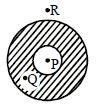
Current is flowing through a conducting hollow pipe whose area of cross-section is shown in the figure. The value of magnetic induction will be zero at
  • A
    points $P, Q$ and $R$
  • B
    point $R$ but not at $P$ and $Q$
  • C
    $Q$ but not at $P$ and $R$
  • $P$ but not at $Q$ and $R$

Answer

Correct option: D.
$P$ but not at $Q$ and $R$
d

Need a full question paper?

Generate a complete, print-ready paper with questions like this in minutes — across 16+ boards, with answer keys.

Start Generating Free

Similar questions

Which of the following statements is false?
Three capacitances of capacity 10 μF, 5 μF and 5 μF are connected in parallel. The total capacity will be
When a current of $2\, A$ flows in a battery from negative to positive terminal, the  potential difference across it is $12\, V$. If a current of $3 \,A$ flows in the opposite  direction potential difference across the terminals of the battery is $15\, V$, the $emf$ of the  battery is ................ $\mathrm{V}$
The current sensitivity of a moving coil galvanometer increases by $20 \%$ when its resistance is doubled. Calculate, by what factor does the voltage sensitivity change?
When two magnetic moments are compared using equal distance method the deflections produced are $45^o$ and $30^o$. If the length of magnets are in the ratio  $1 : 2,$  the ratio of their pole strengths is
The equivalent capacitance between points $A$ and $B$ of the circuit shown will be
If the focal length of objective and eye lens are 1.2 cm and 3 cm respectively and the object is put 1.25 cm away from the objective lens and the final image is formed at infinity. The magnifying power of the microscope is
Which of the following is a fusion reaction?
Two equal charges q of opposite sign separated by a distance 2a constitute an electric dipole of dipole moment p. If P is a point at a distance r from the centre of the dipole and the line joining the centre of the dipole to this point makes an angle θ with the axis of the dipole, then the potential at P is given by (r >> 2a) (Where p = 2qa)
The induction coil works on the principle of