MCQ
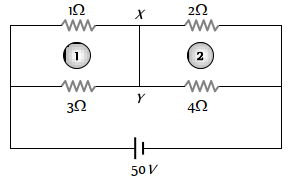
Current through wire $\quad X Y$ of circuit shown is
Image
  • A
    $1 \mathrm{~A}$
  • B
    $4 \mathrm{~A}$
  • $2 \mathrm{~A}$
  • D
    $3 \mathrm{~A}$

Answer

Correct option: C.
$2 \mathrm{~A}$

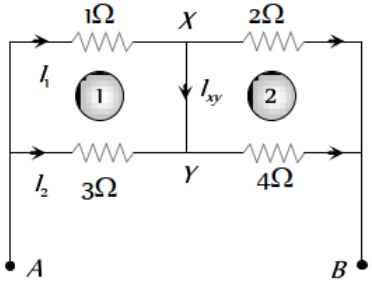
$-i_1+0 \times i_{x y}+3 i_2=0 \text { i.e. } i_1=3 i_2\dots(i)$
Also $-2\left(i_1-i_{x y}\right)+4\left(i_2+i_{x y}\right)=0$
i.e. $2 i_1-4 i_2=6 i_{x y}\dots(ii)$
Also $V_{A B}-1 \times i_1-2\left(i_1-i_{x y}\right)=0 \Rightarrow 50=i_1+2\left(i_1-i_{x y}\right)$
$=3 i_1-2 i_{x y}\dots(iii)$
Solving (i), (ii) and (iii), $i_{x y}=2 A$

Need a full question paper?

Generate a complete, print-ready paper with questions like this in minutes — across 16+ boards, with answer keys.

Start Generating Free

Similar questions

The ends of two rods of different materials with their thermal conductivities, radii of cross-sections and lengths all are in the ratio 1 $: 2$ are maintained at the same temperature difference. If the rate of flow of heat in the larger rod is $44 \mathrm{cal} / \mathrm{sec}$, that in the shorter rod in $\mathrm{cal} / \mathrm{sec}$ will be
Three discs $A, B$ and $C$ having radii $2 m, 4 m$, and $6 m$ respectively are coated with carbon black on their other surfaces. The wavelengths corresponding to maximum intensity are $300 \mathrm{~nm}, 400 \mathrm{~nm}$ and $ 500 n m$, respectively. The power radiated by them are $Q, Q$, and $Q$ respectively
For a particle executing simple harmonic motion, which of the following statements is not correct
Sir C.V. Raman was awarded Nobel Prize for his work connected with which of the following phenomenon of radiation
A sphere of mass $m$, moving with velocity $V$, enters a hanging ban of sand and stops. If the mass of the bag is $M$ and it is raised by height $h$, then the velocity of the sphere was
Emission spectrum of $\mathrm{CO}_2$ gas
A body of mass $2 kg$ is moving with a velocity $8 m / s$ on a smooth surface. If it is to be brought to rest in 4 seconds, then the force to be applied is
On mixing the salt in water, the surface tension of water will
coin is dropped in a lift. It takes time $t_1$ to reach the floor when ift is stationary. It takes time $t_2$ when lift is moving up with constant acceleration. Then
Consider a compound slab consisting of two different materials having equal thickness and thermal conductivities $K$ and $2 K$ respectively. The equivalent thermal conductivity of the slab is