MCQ
$C−X$ bond is strongest in:
  • A
    $\mathrm{CH}_3 \mathrm{Cl}$
  • B
    $\mathrm{CH}_3 \mathrm{Br}$
  • $\mathrm{CH}_3 \mathrm{~F}$
  • D
    $\mathrm{CH}_3 \mathrm{I}$

Answer

Correct option: C.
$\mathrm{CH}_3 \mathrm{~F}$
The carbon$-$halogen bonds $($apart from the carbon$-$iodine bond$)$ are polar, because the electron pair is pulled closer to the halogen atom than the carbon.
This is because $($apart from iodine$)$ the halogens are more electronegative than carbon. The Carbon$-$Fluorine bond is strongest.

Need a full question paper?

Generate a complete, print-ready paper with questions like this in minutes — across 16+ boards, with answer keys.
Start Generating Free

Similar questions

${[Ti{({H_2}O)_6}]^{ + 3}}$ is paramagnetic in nature due to
Ammonium dichromate on heating gives
What happens when a solute crystal is added to a supersaturated solution?
The electrochemical equivalent of a metal is $3.3 \times {10^{ - 7}}\,kg/coulomb$. The mass of the metal liberated at the cathode when a $3\, A$ current is passed for $2$ seconds will be
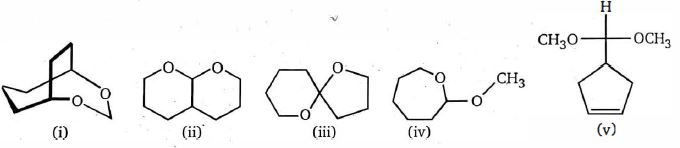
Which of the following compounds ($i$ through $v$) should not be classified as an acetal ?
Which of the following compound is resistant to nucleophilic attack by hydroxyl ions
Which of the following will react faster through $S_{N} 1$ mechanism ?
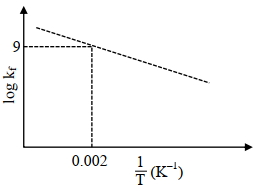
The plot of $\log \mathrm{k}_f$ versus $1 / \mathrm{T}$ for a reversible reaction $\mathrm{A}(\mathrm{g}) \rightleftharpoons \mathrm{P}(\mathrm{g})$ is shown.

(Image)

Pre-exponential factors for the forward and backward reactions are $10^{15} \mathrm{~s}^{-1}$ and $10^{11} \mathrm{~s}^{-1}$, respectively. If the value of $\log \mathrm{K}$ for the reaction at $500 \mathrm{~K}$ is $6$ , the value of $\left|\log \mathrm{k}_{\mathrm{b}}\right|$ at $250 \mathrm{~K}$ is $\qquad$

$[\mathrm{K}=$ equilibrium constant of the reaction

$\mathrm{k}_{\mathrm{f}}=$ rate constant of forward reaction

$\mathrm{k}_{\mathrm{b}}=$ rate constant of backward reaction]
Which is incorrect for given reaction sequence $C{H_3} - CN\xrightarrow[{(2)\,{H_2}O}]{{(1)\,C{H_3}MgBr}}X\xrightarrow{{2,4 - DNP}}Y$
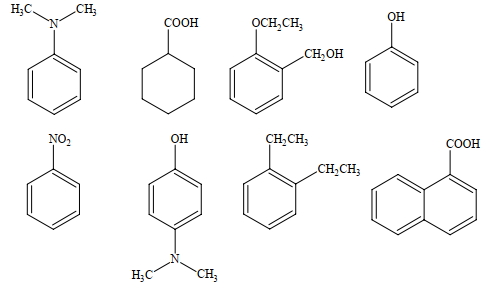
Amongst the following, the total number of compound soluble in aqueous $\mathrm{NaOH}$ is