MCQ
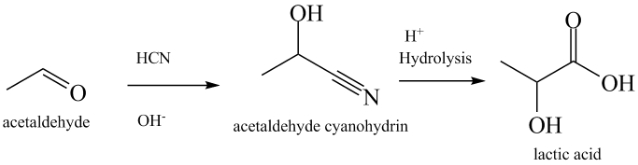
Cyanohydrin of which compound on hydrolysis will give lactic acid?
  • A
    $C_6H_5CHO$
  • B
    $HCHO$
  • $CH_3CHO$
  • D
    $CH_3-CH_2-CHO$

Answer

Correct option: C.
$CH_3CHO$
c
The hydrolysis of acetaldehyde cyanohydrin gives lactic acid.

Need a full question paper?

Generate a complete, print-ready paper with questions like this in minutes — across 16+ boards, with answer keys.

Start Generating Free

Similar questions

The exothermic formation of $Cl{F_3}$ is represented by the equation $C{l_{2(g)}} + 3{F_{2(g)}}$ $\rightleftharpoons$ $2Cl{F_{3(g)}}$; $\Delta H = - 329\,kJ$ Which of the following will increase the quantity of $Cl{F_3}$ in an equilibrium mixture of $C{l_2},\,{F_2}$ and $Cl{F_3}$
The number of possible alkynes with molecular formula ${C_5}{H_8}$ is
The solubility of a sparingly soluble salt $A_x B_y$ in water at $25\,^oC = 1.4 \times 10^{-4}\ M$ . The solubility product is $1.1 \times 10^{-11}$ . The values of $x$ and $y$ may be 
Arrange the following in the order of increasing mass (atomic mass: $O = 16, Cu = 63, N = 14$)

$I.$ one atom of oxygen

$II.$ one atom of nitrogen

$III.$ $1\times10^{-10}$ mole of oxygen

$IV.$ $1\times10^{-10}$ mole of copper

Assertion : Iodine is more soluble in water than in carbon tetrachloride.

Reason : Iodine is a polar compound.

The mass of $BaC{O_3}$ produced when excess $C{O_2}$ is bubbled through a solution of $0.205$ mol $Ba{(OH)_2}$ is ............ $\mathrm{gm}$
An electronic transition from $1s$  orbital of an atom causes
Solubility product of a salt $AB$ is $1\times10^{-8}$ in a solution in which the concentration of $A^+$ ions is $10^{-3}\, M$. The salt will precipitate when the concentration of $B^-$ ions is kept
At $298\, K$, the standard reduction potentials are $1.51\, V$ for $MnO_4^ - \,|\,M{n^{2 + }}$, $1.36\, V$ for $C{l_2}\,|\,C{l^ - }$, $1.07\, V$ for $B{r_2}\,|\,B{r^ - }$ and $0.54\, V$ for ${I_2}\,|\,{I^ - }$. At $pH\, = 3$ , permanganate is expected to oxidize $\left( {\frac{{RT}}{F} = 0.059\,V} \right)$
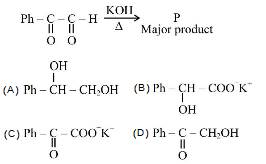
The major product $(\mathrm{P})$ in the following reaction is :
Image