MCQ
Cyclohexane, a hydrocarbon floats on water because
  • A
    It is immiscible with water
  • B
    Its density is low as compared to water
  • C
    It is non-polar substance
  • It is immiscible and lighter than water

Answer

Correct option: D.
It is immiscible and lighter than water
d
(d) Cyclohexane, is immiscible and lighter than water. Hence, floats on the surface of water.

Need a full question paper?

Generate a complete, print-ready paper with questions like this in minutes — across 16+ boards, with answer keys.

Start Generating Free

Similar questions

$17.4\%\, (mass / volume)\, K_2SO_4$ solution at $27\,^oC$ is isotonic to $5.85\%\, (mass / volume)\, NaCl$ solution at $27\,^oC$ . If $NaCl$ is $100\%$ ionised, what is $\%$ ionisation of $K_2SO_4$ in aq. solution ? [At wt. of $K = 39,\, Na = 23$  ]
At $pH =1.2$ and 1 bar pressure, potential of hydrogen electrode at 298 K is __________ [Given : $\log 1.2=0.079$ ]
The equilibrium constant $(K_c) $ for the reaction ${\rm{HA}} + {\rm{B}}$ $\rightleftharpoons$ ${\rm{B}}{{\rm{H}}^+} + {{\rm{A}}^-}$ is $100$. If the rate constant for the forward reaction is $10^5$, then rate constant for the backward reaction is
For the given reaction, which is not used to change the colour ?

${K_2}Cr_2{O_7}/{H^ + } + y \to \mathop {C{r^{ + 3}} + Others}\limits_{(green)\,\,\,\,\,\,\,\,\,\,\,\,\,\,\,\,\,\,\,\,\,\,\,\,\,\,\,\,\,\,\,\,\,\,\,\,} $

For the reaction $A(g) + 2B(g) \to 2C(g) + 3D(g)$, the value of $\Delta E$ at ${27\,^o}C$ is $ 19.0\, kcal$ . The value of $\Delta H$ for the reaction would be.......$kcal$  $(R = 2.0\,cal\,{K^{ - 1}}mo{l^{ - 1}})$
An ideal gas, $\overline{\mathrm{C}}_{\mathrm{V}}=\frac{5}{2} \mathrm{R}$, is expanded adiabatically against a constant pressure of $1 \mathrm{~atm}$ untill it doubles in volume. If the initial temperature and pressure is $298 \mathrm{~K}$ and $5 \mathrm{~atm}$, respectively then the final temperature is. . . . . . .$\mathrm{K}$ (nearest integer). [ $\overline{\mathrm{C}}_{\mathrm{V}}$ is the molar heat capacity at constant volume]
Which one of the following reactions would produce secondary alcohol
The first ionization energy for Li is $5.4 \,eV $ and electron affinity of $Cl$  is $3.61\,eV.$ The $\Delta H$ (in $kJ/mol$) for the reaction $Li(g) + Cl(g) \to L{i^ + } + C{l^ - }$ is (if resulting ions do not combine with each other) $(1\,eV = 1.6 \times {10^{ - 19}}\,J)$
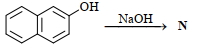
The number of resonance structures for $N$ is
How many products will be formed in above reaction ?