MCQ
$D-$ Glucose and $L-$ Glucose are
  • A
    Diastereomer
  • B
    Epimers
  • Enantiomers
  • D
    $(A)$ and $(B)$ both

Answer

Correct option: C.
Enantiomers
c

Need a full question paper?

Generate a complete, print-ready paper with questions like this in minutes — across 16+ boards, with answer keys.

Start Generating Free

Similar questions

Sea water contains $29.25 \%$ $NaCl$ and $19 \%  \,MgCl _2$ by weight of solution. The normal boiling point of the sea water is $..........{ }^{\circ} C$ (Nearest integer)

Assume $100 \%$ ionization for both $NaCl$ and $MgCl _2$

Given : $K _{ b }\left( H _2 O \right)=0.52\,K\,kg\,mol ^{-1}$

Molar mass of $NaCl$ and $MgCl _2$ is 58.5 and $95\,g$ $mol ^{-1}$ respectively.
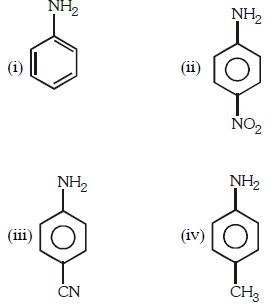
Arrange these compounds in decreasing order of basic strength
The boiling point of $0.2 \,mol\, kg^{-1}$ solution of $X$ in water is greater than equimolal solution of $Y$ in water. Which one of the following statements is true in this case ?
When a metal rod ${M}$ is dipped into an aqueous colourless concentrated solution of compound ${N}$, the solution turns light blue. Addition of aqueous $\mathrm{NaCl}$ to the blue solution gives a white precipitate ${O}$. Addition of aqueous $\mathrm{NH}_3$ dissolves ${O}$ and gives an intense blue solution.

$1.$ The metal rod ${M}$ is

$(A)$ $\mathrm{Fe}$ $(B)$ $\mathrm{Cu}$ $(C)$ $\mathrm{Ni}$ $(D)$ $\mathrm{Co}$

$2.$ The compound ${N}$ is

$(A)$ $\mathrm{AgNO}_3$ $(B)$ $\mathrm{Zn}\left(\mathrm{NO}_3\right)_2$

$(C)$ $\mathrm{Al}\left(\mathrm{NO}_3\right)_3$ $(D)$ $\mathrm{Pb}\left(\mathrm{NO}_3\right)_2$

$3.$ The final solution contains

$(A)$ $\left[\mathrm{Pb}\left(\mathrm{NH}_3\right)_4\right]^{2+}$ and $\left[\mathrm{CoCl}_4\right]^{2-}$

$(B)$ $\left[\mathrm{Al}\left(\mathrm{NH}_3\right)_4\right]^{3+}$ and $\left[\mathrm{Cu}\left(\mathrm{NH}_3\right)_4\right]^{2+}$

$(C)$ $\left[\mathrm{Ag}\left(\mathrm{NH}_3\right)_2\right]^{+}$and $\left[\mathrm{Cu}\left(\mathrm{NH}_3\right)_4\right]^{2+}$

$(D)$ $\left[\mathrm{Ag}\left(\mathrm{NH}_3\right)_2\right]^{+}$and $\left[\mathrm{Ni}\left(\mathrm{NH}_3\right)_6\right]^{2+}$

Give the answer question $1,2$ and $3.$

$\begin{matrix}
   O\,\,\,\,\,\,\,\,\,\,\,\,\,\,\,\,\,\,\,\,\,\,\,\,\,\,\,\,\,\,\,\,\,\,\,\,\,\,\,\,\,\,\,\,\,\,\,\,\,\,\,  \\
   ||\,\,\,\,\,\,\,\,\,\,\,\,\,\,\,\,\,\,\,\,\,\,\,\,\,\,\,\,\,\,\,\,\,\,\,\,\,\,\,\,\,\,\,\,\,\,\,\,\,\,\,\,  \\
   R-C-O-R'+R''OH\overset{{{H}^{\oplus }}}{\longleftrightarrow}  \\
\end{matrix}\begin{matrix}
   O\,\,\,\,\,\,\,\,\,\,\,\,\,\,\,\,\,\,\,\,\,\,\,\,\,\,\,\,\,\,\,\,\,\,\,\,  \\
   ||\,\,\,\,\,\,\,\,\,\,\,\,\,\,\,\,\,\,\,\,\,\,\,\,\,\,\,\,\,\,\,\,\,\,\,\,  \\
   R-C-O-R''-R'OH  \\
\end{matrix}$

Above reaction is/an example of

$\begin{matrix}
   O\,\,\,\,\,\,\,\,\,  \\
   ||\,\,\,\,\,\,\,\,\,\,  \\
   C{{H}_{3}}C{{H}_{2}}-C-C{{H}_{3}}\xrightarrow[HCl]{NaN{{O}_{2}}};  \\
\end{matrix}$ Major product of this reaction is
Which optically active compound on reduction with $LiAlH_4$ will give optically inactive compound ?
.
What is the name of reaction, when phenol is heated with alcoholic KOH and $CHCl _3$ :
$75\% $ of a first order reaction is completed in $30$  minutes. What is the time required for $93.75\%$ of the reaction (in minutes)