$D$ -Glucose $\overset {O{H^ - }} \longleftrightarrow $ $A + B; A$ and $B$ are
Easy


Download our appand get started for free
Experience the future of education. Simply download our apps or reach out to us for more information. Let's shape the future of learning together!No signup needed.*
Similar Questions
- 1Vitamin ${B_{12}}$ contains metalView Solution
- 2The one that does not stabilize $2^{\circ}$ and $3^{\circ}$ structures of proteins isView Solution
- 3View SolutionThe central dogma of molecular genetics states that the genetic information flows from
- 4Which of the following base is found only in $RNA$ but not in $DNA$View Solution
- 5Consider the following reactions :View Solution
$(i)$ Glucose $+ ROH \quad \stackrel{\text { dry } HCl }{\longrightarrow}$ Acetal
$\xrightarrow[{{{\left( {C{H_3}CO} \right)}_2}O}]{{x\,eq.of}}$ acetyl derivative
$(ii)$ Glucose $\xrightarrow{{Ni/{H_2}}}A\xrightarrow[{{{\left( {C{H_3}CO} \right)}_2}O}]{{y\,\,eq.\,of}}$ acetyl derivative.
$(iii)$ Glucose $\xrightarrow[{{{\left( {C{H_3}CO} \right)}_2}O}]{{z\,ed.\,of}}$ acetyl derivative.
$' x ^{\prime},{ }^{\prime} y ^{\prime}$ and ${ }^{\prime} z^{\prime}$ in these reactions are respectively.
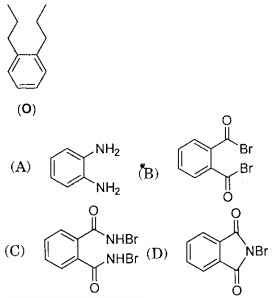
- 6Treatment of compound $O$ with $KMnO_4 / \mathrm{H}^{+}$gave $P$, which on heating with ammonia gave $Q$. The compound $Q$ on treatment with $Br_2 / NaOH$ produced $R$. On strong heating, $Q$ gave $S$, which on further treatment with ethyl $2$-bromopropanoate in the presence of $KOH$ followed by acidification, gave a compound $T$.View Solution
(image)
($1$) The compound $R$ is
(image)
($2$) The compound $T$ is
($A$) glycine
($B$) alanine
($C$) valine
($D$) serine
Given the answer question ($1$) and ($2$)
- 7View SolutionWhich of the following basic amino acid is least basic
- 8Which among the following compounds, is a $\beta$ ketohexo furanose?View Solution
- 9View SolutionGlucose in blood can be quantitatively determined with
- 10$4-$ carbohydrate glucose, lactose , sucrose, starch are present. Different test is carried out with $4-$ carbohydratcs separately. Following observation takes place.View Solution
$(a)$ Heated : it is charred
$(b)$ $I_2$ solution : no violet colour
$(c)$ Fehling solution : reddish brown ppt. is observed
$(d)$ It does not reduce copper$(II)$ acetate to $Cu_2O$ . No red precipiated is observed in $5/ min$
The carboxylate which satisfy all the above observation