MCQ
$D$ -Glucose $\overset {O{H^ - }} \longleftrightarrow $ $A + B; A$ and $B$ are
- A$D$ -Mannose and $D$ -Mannitol
- ✓$D$ -Mannose and $D$ -Fructose
- C$D$ -Allose and $D$ -Altrose
- D$D$ -Glucose and $D$ -Idose
Generate a complete, print-ready paper with questions like this in minutes — across 16+ boards, with answer keys.
$CH_3 - O - CH(CH_3)_2 + HI \to$ products
The above reaction has been studied at $800^{\circ} C$. The related data are given in the table below.
| Reaction serial number | Initial pressure of $H _{2}$ / $kPa$ | Initial Pressure of $NO /$ $kPa$ | Initial rate $\left(\frac{- dp }{ dt }\right) /( kPa / s )$ |
| $1$ | $65.6$ | $40.0$ | $0.135$ |
| $2$ | $65.6$ | $20.1$ | $0.033$ |
| $3$ | $38.6$ | $65.6$ | $0.214$ |
| $4$ | $19.2$ | $65.6$ | $0.106$ |
The order of the reaction with respect to $NO$ is $...........$
$Image$
In this reaction, $\mathrm{RCONHBr}$ is formed from which this reaction has derived its name. Electron donating group at phenyl activates the reaction. Hofmann degradation reaction is an intramolecular reaction.
$1.$ How can the conversion of $(i)$ to $(ii)$ be brought about?
$(A)$ $\mathrm{KBr}$ $(B)$ $\mathrm{KBr}+\mathrm{CH}_3 \mathrm{ONa}$ $(C)$ $\mathrm{KBr}+\mathrm{KOH}$ $(D)$ $\mathrm{Br}_2+\mathrm{KOH}$
$2.$ Which is the rate determining step in Hofmann bromamide degradation?
$(A)$ Formation of $(i)$ $(B)$ Formation of $(ii)$ $(C)$ Formation of $(iii)$ $(D)$ Formation of $(iv)$
$3.$ What are the constituent amines formed when the mixture of $(i)$ and $(ii)$ undergoes Hofmann bromamide degradation?
$Image$
give the answer question $1$, $2$, and $3.$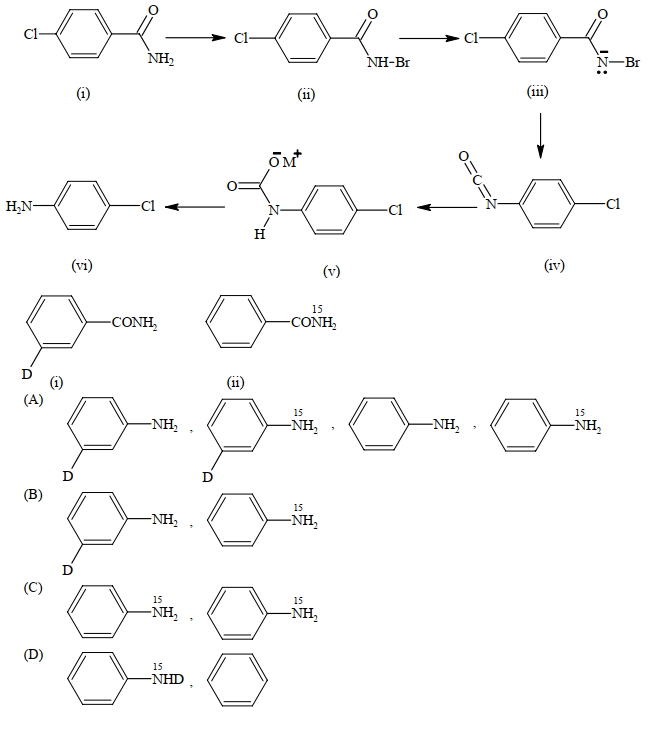
(Round of to the Nearest Integer).
(Given : $\left. R =8.314\, J\, mol ^{-1} K ^{-1}\right)$
$E^o_{Cl_2/Cl^-} = 1.36\,V,$ $E^o_{Cr^{3+}/Cr}= -0.74\,V,$
$E^o_{Cr_2/O_7^{2-}/Cr^{3+}}=1.33\,V,$ $E^o_{MnO^-_4/Mn^{2+}} = 1.51\,V$
Among the following, the strongest reducing agent is