MCQ
${d \over {dx}}\{ {e^{ - a{x^2}}}\log (\sin x)\} = $
  • A
    ${e^{ - a{x^2}}}(\cot x + 2ax\log \sin x)$
  • B
    ${e^{ - a{x^2}}}(\cot x + ax\log \sin x)$
  • ${e^{ - a{x^2}}}(\cot x - 2ax\log \sin x)$
  • D
    None of these

Answer

Correct option: C.
${e^{ - a{x^2}}}(\cot x - 2ax\log \sin x)$
c
(c) $\frac{d}{{dx}}\{ {e^{ - a{x^2}}}\log (\sin x)\} $

$ = {e^{ - a{x^2}}}( - 2ax).\log (\sin x) + {e^{ - a{x^2}}}\cot x$

$ = {e^{ - ax}}^2[\cot x - 2ax\log (\sin x)]$.

Need a full question paper?

Generate a complete, print-ready paper with questions like this in minutes — across 16+ boards, with answer keys.

Start Generating Free

Similar questions

Let $\mathrm{H}_1, \mathrm{H}_2, \ldots, \mathrm{H}_{\mathrm{n}}$ be mutually exclusive and exhaustive events with $\mathrm{P}\left(\mathrm{H}_{\mathrm{i}}\right)>0, \mathrm{i}=1,2, \ldots, \mathrm{n}$. Let $\mathrm{E}$ be any other event with $0<\mathrm{P}(\mathrm{E})<1$.

$STATEMENT -1$ : $\mathrm{P}\left(\mathrm{H}_{\mathrm{i}} \mid \mathrm{E}\right)>\mathrm{P}\left(\mathrm{E} \mid \mathrm{H}_{\mathrm{i}}\right) \cdot \mathrm{P}\left(\mathrm{H}_{\mathrm{i}}\right)$ for $\mathrm{i}=1,2, \ldots, \mathrm{n}$ because

$STATEMENT$ $-2: \sum_{1=1}^{\mathrm{n}} \mathrm{P}\left(\mathrm{H}_{\mathrm{i}}\right)=1$

If the vectors $3\hat{\text{i}}+\lambda\hat{\text{j}}+\hat{\text{k}}$ and $2\hat{\text{i}}-\hat{\text{j}}+8\hat{\text{k}}$ are perpendicular, then $\lambda$ is equal to:
$\int_{}^{} {\frac{{{x^2} + x - 1}}{{{x^2} + x - 6}}\;dx = } $
Let the set of all values of $p$, for which

$f(x)=\left(p^2-6 p+8\right)\left(\sin ^2 2 x-\cos ^2 2 x\right)+2(2-p) x+7$ does not have any critical point, be the interval $(a, b)$. Then $16 a b$ is equal to ..........
Which of the following is incorrect
Let $f(x) = ax + b$ and $g(x) = cx + d,\;a \ne 0,\;c \ne 0$. Assume $a = 1,\;b = 2$. If $(fog)(x) = (gof)(x)$ for all $x$, what can you say about $c$ and $d$
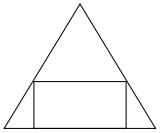
If a rectangle is inscribed in an equilateral triangle of side length $2 \sqrt{2}$ as shown in the figure, then the square of the largest area of such a rectangle is $....$
Let $\text{f(x)}=\text{x}+\text{b}|\text{x}|+\text{c}|\text{x}|^4,$ where $a, b,$ and $c$ are real constants. Then, $f (x)$ is differentiable at $x = 0,$ if :
If one of the roots of $\left |\begin{matrix} 3 &\text{amp; 5} &\text{amp; x}\\ 7 &\text{amp; x} &\text{amp; 7}\\ \text{x} &\text{amp; 5} &\text{amp; 3}\end{matrix}\right |=0$ is $-10,$ the other roots are:
Let $f$ be a function defined on $R$ (the set of all real numbers) such that $f^{\prime}(x)=2010(x-2009)(x-2010)^2$ $(x-2011)^3(x-2012)^4$, for all $x \in R$. If $g$ is a function defined on $R$ with values in the interval $(0, \infty)$ such that $f(x)=\ln (g(x))$, for all $x \in R$, then the number of points in $R$ at which $g$ has a local maximum is